
Archives
All posts by thebestmusicyouhaveneverheard

The question is no longer whether the automatic spending cuts of budget “sequestration” will start to take effect on Friday. The question is how long lawmakers are willing to let those cuts stay in place. That, in turn, will depend on how quickly—and how severely—the cuts affect people’s lives.
President Obama and his allies predict dire consequences, for the economy and for a wide array of government services. On Sunday, they released a report detailing how the cuts would play out in particular states. Kids in Georgia wouldn’t get their vaccines, defense contractors in Texas would lose work, teachers in Ohio would end up on furlough—the list goes on. Republicans and their allies have answered by suggesting the administration is exaggerating. “Over the next ten years, the sequester amounts to a $1.16 trillion cut, or roughly 3 cents on every federal dollar,” National Review editor Rich Lowry wrote on Friday. “If we can’t squeeze a couple of pennies out of every dollar, we might as well begin our great national bankruptcy proceedings right now.”
Sorry, but squeezing a couple of pennies out of every dollar in the next year is a terrible idea. In absolute terms, government spending is significantly higher than it was a decade ago. But that’s largely a product of two factors. One is health care, the cost of which the government shoulders mostly through Medicare and Medicaid. The other is a temporary burst of spending from the Recovery Act, which was designed to stop the economy from collapsing in 2009. That spending is mostly finished anyway. And the sequester cuts woudln’t meaningfully reduce health care spending, though they would cut Medicare reimbursements. They would primarily affect “discretionary” spending, which includes everything from workplace safety inspections to defense spending to Head Start. As the graph here shows, discretionary spending—measured as a percentage of gross domestic product—is already lower than it was when Obama took office. The sequester cuts would reduce it further. At those historically low levels, severe cuts to government services are virtually inevitable, whether or not they are precisely the ones that the administration is predicting.

The effect on the economy could be equally blunt. The recovery is already pretty weak. Taking money out of it, which is what the sequester cuts would do, would make it weaker. Non-partisan analysts, including those at the Congressional Budget Office and private firms like Macroeconomic Advisers, predict that the sequester cuts would reduce growth by anywhere from a half to a full percentage point in the next year. That would probably reduce the number of jobs in the economy by a few hundred thousand. The unemployment rate, which has been slowly dropping, would probably remain at around 8 percent. By the way, it’s entirely possible the economy is already suffering because of the sequester cuts: Many analysts believe that decline in defense spending, in anticipation of the automatic cuts, are the reason the economy unexpectedly (and distressingly) shrunk in the final quarter of 2012.
To be fair, even conservatives don’t think the sequestration is a smart way to pare the budget. “It’s a terrible way to cut spending,” Senator Tom Coburn, Republican of Oklahoma, said on Fox News Sunday. But he and his allies obviously think the sequester cuts are preferable to Obama’s alternative, which would replace the sequester cuts with a mix of spending cuts (spread more carefully across discretionary spending and entitlements, including health care) and tax increases (via tax reform that closes loopholes benefiting the wealthy). In much the same way, Obama and the Democrats hate the sequester cuts less than they hate the Republican alternative, which would significantly reduce spending on programs for low-income people in order to protect the defense budget.
On balance, the public’s preferences are probably closer to Obama’s. That’s why Republicans are arguing the sequester cuts won’t hurt so much. Of course, within a week or two, political rhetoric may matter a lot less than longer lines at airport security, smaller unemployment checks, and other reminders that less government spending also means fewer government services.
(Thanks to Huffington Post for the Headline and article!)
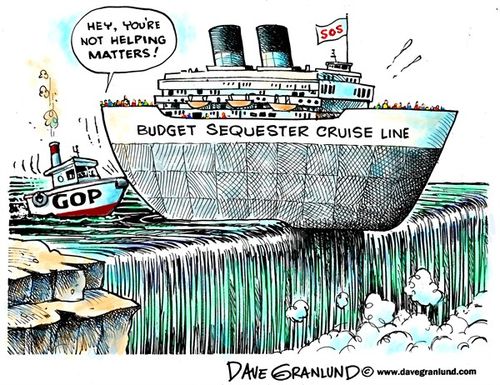
Republicans keep pushing….pay no attention to the waterfall………..


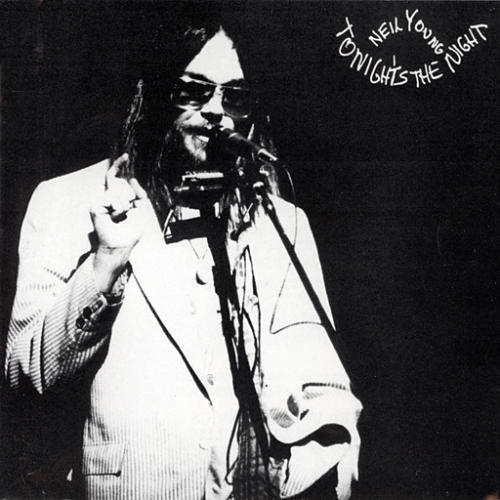
Today is your lucky day…..I have a Neil Young Three’fer for you instead of our normal Two’fer.
Last week I was listening to my copy of Neil’s 1976 retrospective, Decade, and reading the liner notes for the first time in many years. His liner note for Heart of Gold from the Harvest album (his only #1 hit single) caught my attention….
This song put me in the middle of the road. Travelling there soon became a bore so I headed for the ditch. A rougher ride but I saw more interesting people there.
The end result of Neil heading for the ditch was three albums that are now referred to as the Ditch Trilogy…..
- Time Fades Away
- On The Beach
- Tonights the Night
These albums are about as far away from the middle of the road sound of Harvest album as you can get. Some people hate them but they are among my favorites. They are raw, powerful, and serve as a living reminder of Neil’s absolute artistic integrity. Let’s listen to a song from each of these albums.
Don’t Be Denied (Time Fades Away)
Revolution Blues (On The Beach)
Borrowed Tune (Tonights The Night)
So, if you have wondered why I have dragged this blog back into the on-going political fray about Sequestration…..let’s just say I headed for the ditch 🙂
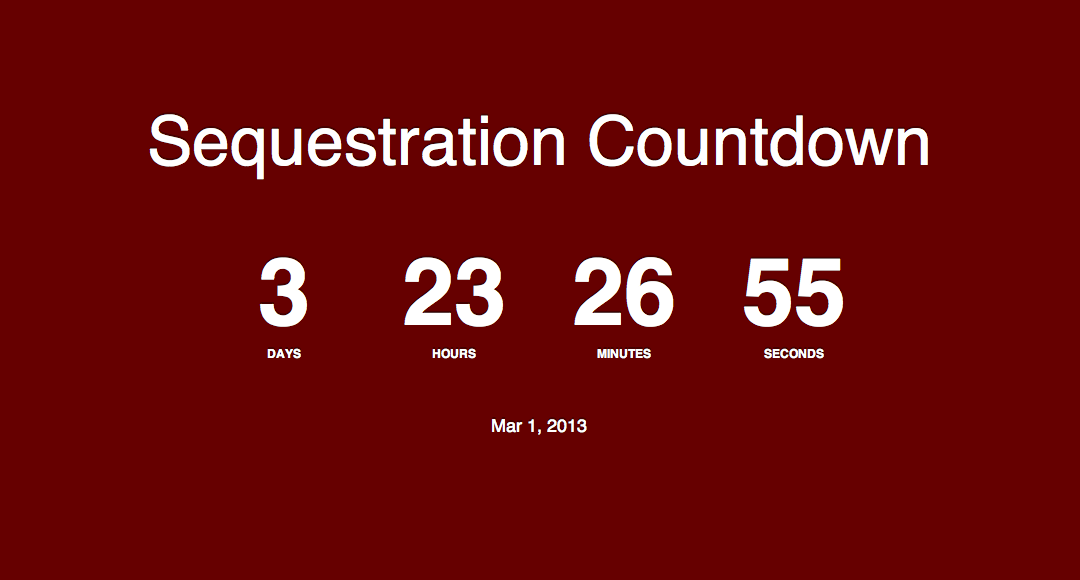
Sequestration: “Dr. Strangelove” and The Death of a Thousand Cuts!
By: Eugene Elander

With exquisite timing, during these final stages leading up to our pending federal Sequestration self-inflicted disaster, the Cold War’s notorious movie “Dr. Strangelove, or How I Learned to Stop Worrying and Love the Bomb” has been airing on Blockbuster TV. In that bizarre film, a few deranged generals and a mad scientist start World War III through evading, avoiding, and destroying all of the safeguards against nuclear war, in an act of self-immolation which, unfortunately, takes the world with them. Much the same process has emerged during the countdown to a Sequestration disaster of epic proportions. In the present circumstances, however, America will suffer “the death of a thousand cuts” rather than a nuclear disaster.
Watching the Sequestration Waltz play out in this final week before the event occurs, nearly all observable effort is being placed on the usual blamesmanship between Republicans in Congress and the President in the White House. It makes little real difference which side has done more to cause this pending disaster, which will essentially shut down the Federal government — with consequences including the vast reduction of most vital government services, from air traffic control to the safety inspection of our food supply to the provision of essential funding to state and local governments. What is obviously needed is a sensible compromise between the Democratic requirement for both revenue increases and measured spending cuts, and the Republican determination that only spending cuts occur, with no tax increases on anyone — not even on any giant corporations which have essentially escaped meaningful taxation for decades.
Sadly, just as there was no possibility of compromise over all-out nuclear war in “Dr. Strangelove,” there appears to be zero willingness on the part of our two major political parties to compromise to avoid this Sequestration disaster. As the rhetoric becomes more and more heated, while the countdown to fiscal armageddon continues, leaders of both parties pour gasoline on the Sequestration fire in order to score futile political points against the opposition. Instead of reasoned debate, what America observes is essentially on the level of a third-grade food fight in the school cafeteria — a fight which nobody is going to win!
There are only a few days left to avoid so-called Sequestration, which would better be termed: The Death of a Thousand Cuts. The irony here is that, at the time when we were approaching the Federal debt limit at the end of 2011, Sequestration was nor really proposed as any sort of remedy. Rather, it was proposed as being so awful that our federal government would never, ever let it occur — the idea then was that we would be forced to solve our fiscal problems by this Sword of Damocles hanging over us. Whoever came up with that high-risk approach (and there are numerous versions of just how this faulty concept emerged) failed to understand the deep enmity between our political parties.
This enmity is nothing very new; not long after President Obama was elected to his first term, such Republican leaders as Senator Mitch McConnell stated publicly and frequently that the main goal for their party should be to block Obama from re-election while preventing any of his initiatives, such as what has come to be known as Obamacare, from passing in Congress. There is, however, a very significant difference between the two Parties on the matter of Sequestration. While the Republicans seem willing to go to any extreme in damaging the nation if they think it will damage our President, the Democrats continue to propose reasonable and balanced alternatives to a federal government shutdown. Now, America is waiting for those alternatives to be taken seriously.
Those proposals, however, seem to fall on very deaf ears and very blind eyes across the Congressional aisle. Yes, there is plenty of blame to go around — and, yes, it does indeed take “two to tango.” Still we must recognize that there is one major difference here: the Democrats devoutly seek to save America from a fiscal disaster, while the present crop of Congressional Republicans seem perfectly willing to impose The Death of a Thousand Cuts, Sequestration, as they believe it will damage their opponents more than themselves. Dr. Strangelove would indeed have understood.


Sequestration Sacrifices Jobs To Save Billionaire Tax Breaks
By: John Nichols
There is a great deal of talk about how Republican senators have gone off the rails in their opposition to the nomination of former Senator Chuck Hagel to serve as Secretary of Defense. And there have been some bizarre deviations, with senators making pronouncements based on internet rumors and unfounded speculation.
But none of the fantastical filibustering of the Hagel fight can compare with the delusional dialogue regarding the federal budget.
To hear the billionaire proponents of austerity tell it, America is teetering on the brink of economic ruin. America, we are told, is broke. And the only answer is to “Fix the Debt” with deep spending cuts followed by the radical reordering of Social Security, Medicare and Medicaid.
But America is not broke.
America has broken priorities.
That’s what the billionaire proponents of cuts-at-any-cost economics won’t acknowledge as they advance a “Fix the Debt” agenda that imposes austerity on everyone else, while stacking the deck in their favor.
It is vital to understand that there is an economically and socially viable alternative to austerity cuts. It’s a growth agenda that addresses waste, fraud and abuse while finding new revenues to invest in job creation, education and expansion of access to healthcare.
The growth agenda, as proposed in the “Balancing Act” advanced by leaders of the Congressional Progressive Caucus, asks billionaires to pay their fair share in order to expand employment and opportunities.
The austerity agenda asks everyone but the billionaires to pay: via cuts not just to benefits and services but to jobs.
The anticipated March 1 sequestration, which proposes across-the-board cuts, is an example of austerity.
It continues a two-year-long process of slashing federal programs that are of value to Americans.
But it demands nothing new of billionaires and corporations that are on the winning end of rapidly expanding income inequality.
If we have learned anything from cuts in Europe it is that with austerity comes unemployment.
Even Barack Obama’s critics tend to shy away from arguing against the reality that the president was right when he said: “These cuts are not smart, they are not fair, they will add hundreds of thousands of people to the unemployment rolls. This is not an abstraction. People will lose their jobs. The unemployment rate might tick up again.”
The only place for quibbling is with the word “might.”
Austerity, in the form of the sequestration of federal spending that is set to begin March 1, will result in job losses.
Austerity in the the form of a renewed push by Alan Simpson, Erskine Bowles and the billionaire-backed “Fix the Debt” campaign to assault Social Security, Medicare and Medicaid, has the potential to lead to even more significant job losses.
How many jobs? The most hopeful estimates begin in the range of the 700,000 losses predicted by the Macroeconomic Advisers research group. But they could go much higher, according to an October report to Congress by the Congressional Research Service.
But the sequestration is not the worst of it.
The sequestration is the start, not the finish, of a process that undoes economic recovery and causes job losses to spike by even greater numbers.
Simpson and Bowles are back, promoting schemes such as “chained CPI,” the slashing of cost-of-living increases for Social Security recipients that will squeeze the buying power of seniors and people with disabilities and further impede economic growth.
That will cost even more jobs. And why?
In the case of the sequestration fight, to preserve tax loopholes that benefit millionaires and billionaires and multinational corporations that shift jobs overseas.
In the case of Simpson-Bowles, to lower top marginal tax rates that benefit millionaires and billionaires and multinational corporations that shift jobs overseas.
This is what austerity is all about: exploiting fiscal challenges in order to redistribute the wealth upward.
Louis Brandeis argued in another era of wrangling over economic and fiscal policy: “We must make our choice. We may have democracy, or we may have wealth concentrated in the hands of a few, but we can’t have both.”
Today we may say, extending upon the wisdom of Justice Brandeis, that “we must make our choice. We may have a measure of economic democracy and with it job growth, or we may have austerity with the purpose of further concentration of wealth in the hands of a few, but we can’t have both.”
(Thanks to OpEdNews for this article)
Here is a great cartoon about the relationship between the Republicans (i.e. The GOP) and The Rich!


WASHINGTON — Outgoing Transportation Secretary Ray LaHood has a frightening message: Air travel could get worse.
The Obama Cabinet member and former Republican congressman made a surprise appearance at Friday’s White House press briefing to warn that the looming automatic budget cuts set to go into effect on March 1 could lead to even longer air travel delays.
“Travelers should expect delays of up to 90 minutes at peak airports during sequester,” starting on April 1, LaHood said. “It’s going to be very painful for the flying public.”
The sequester’s across-the-board budget cuts will slash $600 million from the Federal Aviation Administration, which will in turn have to furlough air traffic controllers. More than 100 air traffic control towers will be shuttered, LaHood said.
He said airlines would accomodate the cuts by providing less service. “We expect that they will change their schedules and cancel flights,” he said.
 Extensive flight delays will occur if the sequester takes place. (Joe Raedle/Getty Images)
Air travel in the U.S. already is no picnic, with rising fares, new fees and long security lines. The delays LaHood outlined perhaps would be a much more tangible — and annoying — result of sequestration than some of the cuts’ other consequences.
“Nobody likes a delay, nobody likes waiting in line. If we can’t get our hamburger within 5 minutes, if we can’t get on the plane within 30, 40, 50 minutes of getting through, they’re going to start calling their member of Congress,” LaHood said of air travelers.
The transportation secretary’s solution? Get Republicans back to the negotiating table to hammer out a deal and avert the sequester.
“I suggest my colleagues on the Republican side go see the movie ‘Lincoln,'” LaHood said, noting that in the Spielberg film, people on both sides talked to each other.
President Obama called Sen. Mitch McConnell and House Speaker John Boehner on Thursday, but negotiations to avert sequestration remain at a standstill.
“I would describe my presence here with one word: Republican,” LaHood said. “They’re hoping maybe I can influence some people in my own party.” He added he had been speaking to about a half-dozen Republican members of Congress in hopes that they will agree to a deal.
(Thanks to Huffington Post for this article)
My sequestration posts have been pretty serious recently. Here is something that will hopefully make you laugh…..

Thanks to http://www.cagle.com for this cartoon!
Protest Music has always been part of American music and it still is today. It is not something that you hear about on a daily basis but it is always there lurking in the background.
In some ways, it is somewhat like the “room of requirement” from Harry Potter in that was always there when it was really needed. Think about the song Ohio from Crosby, Stills, Nash, and Young. Neil Young wrote the song immediately after David Crosby showed him Life Magazine photos of the National Guard gunning down students at Kent State during an antiwar protest. The band recorded the song that night and it was released in a a matter of a couple of weeks. There was a need and the perfect song was there. Let’s listen…..
I can still remember hearing the song on the radio the first time. Of course I had already heard of what happened at Kent State. I couldn’t believe that our government had shot down innocent college student but I felt powerless and alone. Ohio captured every emotion I felt but was unable to convey and, most importantly, after hearing the song I knew I was not alone in having those feelings….I was part of a group. It was perfect.
In other cases protest music is already written and is just waiting for the right moment. In this way it is like a lot of modern technological innovations that get invented before there is an application for them. Let me give you an example from a recent article that i read in Wired Magazine.
Don Stookey knew he had botched the experiment. One day in 1952, the Corning Glass Works chemist placed a sample of photosensitive glass inside a furnace and set the temperature to 600 degrees Celsius. At some point during the run, a faulty controller let the temperature climb to 900 degrees C. Expecting a melted blob of glass and a ruined furnace, Stookey opened the door to discover that, weirdly, his lithium silicate had transformed into a milky white plate. When he tried to remove it, the sample slipped from the tongs and crashed to the floor. Instead of shattering, it bounced.
The future National Inventors Hall of Fame inductee didn’t know it, but he had just invented the first synthetic glass-ceramic, a material Corning would later dub Pyroceram. Lighter than aluminum, harder than high-carbon steel, and many times stronger than regular soda-lime glass, Pyroceram eventually found its way into everything from missile nose cones to chemistry labs. It could also be used in microwave ovens, and in 1959 Pyroceram debuted as a line of space-age serving dishes: Corningware.
The material was a boon to Corning’s fortunes, and soon the company launched Project Muscle, a massive R&D effort to explore other ways of strengthening glass. A breakthrough came when company scientists tweaked a recently developed method of reinforcing glass that involved dousing it in a bath of hot potassium salt. They discovered that adding aluminum oxide to a given glass composition before the dip would result in remarkable strength and durability. Scientists were soon hurling fortified tumblers off their nine-story facility and bombarding the glass, known internally as 0317, with frozen chickens. It could be bent and twisted to an extraordinary degree before fracturing, and it could withstand 100,000 pounds of pressure per square inch. (Normal glass can weather about 7,000.) In 1962 Corning began marketing the glass as Chemcor and thought it could work for products like phone booths, prison windows, and eyeglasses.
Yet while there was plenty of initial interest, sales were slow. Some companies did place small orders for products like safety eyeglasses. But these were recalled for fear of the potentially explosive way the glass could break. Chemcor seemed like it would make a good car windshield too, and while it did show up in a handful of Javelins, made by American Motors, most manufacturers weren’t convinced that paying more for the new muscle glass was worth it—especially when the laminated stuff they’d been using since the ’30s seemed to work fine.
Corning had invented an expensive upgrade nobody wanted. It didn’t help that crash tests found tat “head deceleration was significantly higher” on the windshields—the Chemcor might remain intact, but human skulls would not.
After pitches to Ford Motors and other automakers failed, Project Muscle was shut down and Chemcor was shelved in 1971. It was a solution that would have to wait for the right problem to arise.
The right problem for Chemcor ended up being one posed by Steve Job from Apple Computers in 2007. He needed Corning to produce millions of square feet of ultrathin, ultrastrong glass that didn’t yet exist for a new device that Apple was working on called the iPhone. The work that corning had done on Chemcor allowed them to produce what is now know as Gorilla Glass, a product that is now featured on more than 750 products and 33 brands worldwide. Chemcor had finally found its problem.
(Read the full Wired Magazine article at: http://www.wired.com/wiredscience/2012/09/ff-corning-gorilla-glass/all/)
Some protest music is like Chemcor. As an example, Charles Albert Tindley wrote a song called “I’ll Overcome Someday” in the early 1900s. Here is a 1930 performance of the song by Caldwell Bracy at the King Edward Hotel in Jackson, Mississippi.
The song was brought to the Highlander Folk School (a school that trained union organizers, in the 1930s by tobacco workers from Charleston, South Carolina. Songwriters including Pete Seeger and Guy Carawan, heard it at the school and altered Tindley’s refrain “I’ll Overcome Someday” to “We Shall Overcome” and the resulting song became the theme song of the US Civil Rights Movement in the 1960s. I’ll Overcome Someday had found it’s problem. (Thanks to Wikipedia for providing source material about We Shall Overcome) Here is Bruce Springsteen’s version of We Shall Overcome that he recorded as part of his tribute to Pete Seeger. Let’s listen…..
The next installment of the American Protest Music series will start to investigate the some of our earliest examples of Protest Music. Stay tuned…….
As always, let me know what you think!

Republicans Will Lose on the Sequester
by David Frum Feb 20, 2013 2:34 PM EST

What is the sequester battle? In a nutshell, it’s an attempt to refight the 2012 election, only this time on terms way less favorable to Republicans.
Republicans want to move early to a balanced budget. They want to reach balance through spending cuts only, no tax increases. And they want the spending cuts to fall more heavily on social programs than defense, while exempting Medicare and Social Security for current beneficiaries.
The president wants to move later to a balanced budget. He wants to rely more on tax increases, and he wants the spending cuts to apply to Medicare as well as discretionary spending.
We presented those two options to the American people in November, and the president’s option prevailed. Now Republicans want to present the same choice again.
But this time, they will be presenting the choice under extra disadvantages.
1) President Obama is more popular now than he was in November.
2) Republicans no longer have the coordinated voice and decision-making of a presidential campaign.
3) Because the sequester mechanism grants substantial discretion to the executive to determine where the cuts fall, the president gains powerful new leverage to frame the budget choice in ways maximally embarrassing to Republicans.
4) Because sequester cuts will fall on defense, Republicans will lose the support of important elements of their coalition as the contest continues.
Republicans should not try to reshape the government of the United States from the House of Representatives. That always fails. Instead, they should be focusing on these two missions:
A) Work to temper and mitigate the worst of the president’s agenda – and especially the tax increases and regulations coming in Obamacare, and
B) Begin now to frame the 2014 and 2016 choice in ways advantageous to Republicans.
What they are doing now makes neither tactical nor strategic sense. The likeliest outcome of the sequester fight for Republicans is yet another after yet another political defeat.
(Thanks to the Daily Beast for this article)
Before we end today, let’s talk about why the Republican’s are refusing to negotiate…….they are against President Obama’s proposed closing of tax loopholes for the wealthy, such as the one that keeps tax rates on capital gains and dividends low (i.e. they are protecting the likes of Mitt Romney and the rest of the 1%). Here is the punch line….dividends and capital gains are the biggest contributor to income equality is in the United States (see the graph below). In short, the Republican strategy is to continue to ensure that the 1% get richer and richer while the middle class and the poor bear the complete burden of reducing the deficit. There is nothing new to this but I think it is important to continually remind folks what the Republicans are all about.


