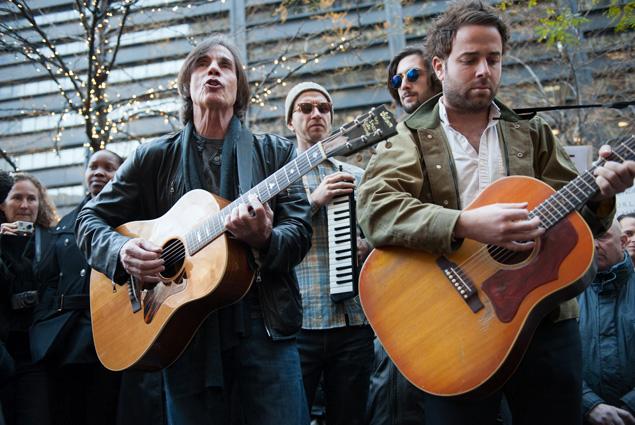
Today’s Sunday Session features one of my all time favorite performers, Jackson Browne, performing with the group that released my favorite record this year, Dawes, during the Occupy Wall Street protests. Enjoy….
Today’s Sunday Session features one of my all time favorite performers, Jackson Browne, performing with the group that released my favorite record this year, Dawes, during the Occupy Wall Street protests. Enjoy….
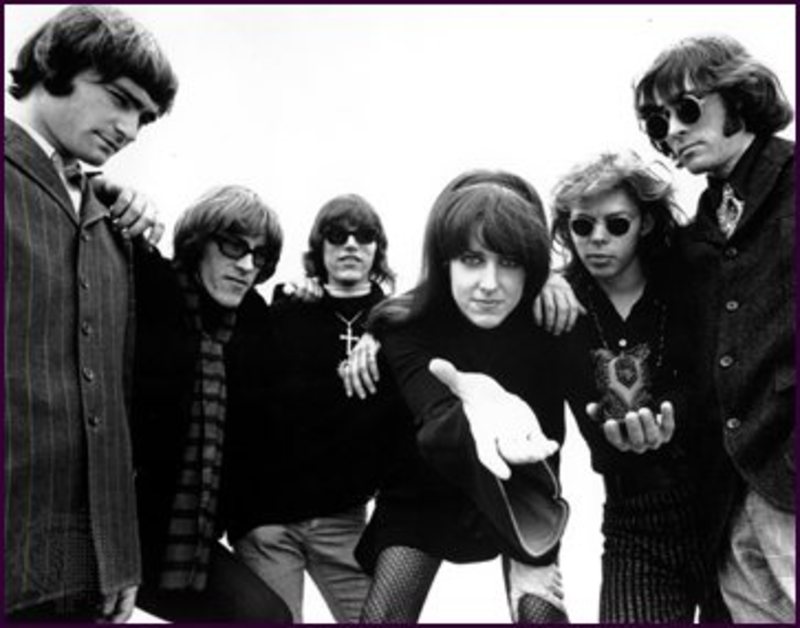
I have a special treat for you today. A great documentary about, Jefferson Airplane, the best of the San Francisco bands from the 1960s. This is true rock history, some amazing rock music, and a chance to observe the beautiful and talented Grace Slick in her prime. Enjoy……

If you had any doubts as to the smartest person in Crosby, Stills, and Nash I think this interview with Graham will convince you that it’s him. He’s not just a great musician and an accomplished photographer…..he’s also a successful entrepreneur. I think you will enjoy this video……..
As much as I enjoyed the interview, we can’t leave without at least one song from Graham. Here’s a really good 1874 solo performance from the Old Grey Whistle Test……
Graham Nash – Old Grey Whistle Test (1974)

Today’s post continues our CSN focus with a great 1972 TV show about Stephen Stills. This provides some great insight into Stephen at the height of his musical power. As always, let me know what you think…….
Part 1
Part 2
Part 3
Part 4

Continuing our CSN focus for this week I have a wonderful treat for you today…..a recent video of David Crosby singing Joni Mitchell’s For Free during a photo shoot. This is really good stuff……
Since it’s Two’Fer Tuesday here is a great video of Joni singing For Free on BBC from 1970.

Here’s a an interesting TV profile of Crosby, Stills, and Nash from 1987. It’s brutal but very interesting at the same time. You might want to look away but I suggest you watch………

I would love to be able to travel back in time…..unfortunately i read an article on Huffington Post yesterday where Brian Cox, a particle physicist, states that time travel is possible but only to the future…..
We may be able to book our ticket to the future someday — it’ll just be a one-way trip.
In a presentation at the British Science Festival, particle physicist Brian Cox said that time travel is possible but only in one direction.
“The central question is, can you build a time machine? The answer is yes, you can go into the future,” the University of Manchester professor told the audience during his hour-long speech on Tuesday, according to The Telegraph. “You’ve got almost total freedom of movement in the future.”
You might be asking yourself why would I like to travel to the past? The answer is simple….that is where most of the music that I like was recorded and I would like to be back there to observe and participate in realtime. Who wouldn’t want to travel back in time and go to Woodstock? Even better….who wouldn’t want to go back in time and be in the recording studio when some of the great music of all time was being recorded?
All of this brings us to a new series of posts that I call Time Machine Tunes, or TMT for short. This is not just old music….I am talking about rare bootleg recordings from studio sessions or concerts. I have spent years gathering such recordings and have not chosen to share them on the blog until now. The songs in these posts will only be available on this site and I hope that you will enjoy them. As always let me know what you think.
Be looking for the first post in this series sometime next week.

I can still remember the first time I heard this song. It was 1970 and I was on my way home from school. All of a sudden this great song was blasting out of the car radio and I was immediately smitten. The guitar sound was amazing. Here is what Russell DaShiell, the lead guitarist during the recording session has to say about how that sound was achieved (thanks to Wikipedia for this information)…..
I actually played the lead guitar parts on Spirit, using a 61-62 SG Les Paul, a 68 Marshall Plexi 100w half stack and a home-made overdrive box in front of the Marshall. Regarding the ‘beep beeps’ as I call them, when the producer asked me to play some fills in between the verses, as a joke I said how about something spacey like this and I did the pickup switch/string bending thing. I saw him stand up in the control booth and he said “that’s it! let’s record that!” so we did. (There was no slide involved, just my fingers, and I used the bridge humbucker and the pickup switch). The fuzz part is Norman with a built-in overdrive circuit built into his Tele pickguard. I’ve been asked a lot over the years how I did the ‘beep beep’ guitar parts on Spirit, so for any guitar players out there who would like to learn how, try the following: Using a 2-pickup Gibson, set the neck pickup volume to zero, bridge pickup volume to max, with the pickup switch in the middle position (with Gibson wiring this gives you silence in the middle position). Do a string bend, picking the B & E strings together with one hit, just ahead of the beat, then use the pickup switch to kick in the bridge pickup in triplets (6 per bar) as you let the B string bend down two frets. I mainly used two positions on Spirit, which is in the key of A. For the low position, fret a stationary C note (8th fret) on the E string while bending the B string up to an A note for your starting-position, then pick the two strings together once while the guitar is silent and work the pickup switch as you let the A note bend downwards to a G. For the high position, do the same thing at the 15th fret holding a stationary high G note on the E string while bending down from E to D on the B string.””I must give credit to Jimi Hendrix as my inspiration for this technique (as well as for the double-string riffs I did at the beginning of the Spirit solo tail section). I saw him perform live in a small club in Madison, Wisconsin and loved the way he used his Strat pickup switch to create staccato feedback on songs like Voodoo Child. The difference is, on a Gibson you can start from silence and create the on/off effect, which worked well with the downward string bending thing I did on Spirit.
Let’s listen to the whole song so you can enjoy the great opening Riff in context…….
I am sad to say that Norman was a “one hit wonder” but if you are only going to produce one hit it might as well be something as great as Spirt In The Sky.
Oh……one more thing. You would never know if from the song’s lyrics but Norman Greenbaum is Jewish 🙂

You might have noticed that I changed the What I’m Listening To area of the blog to “Say Grace”, the new album from a man name Sam Baker. I am betting that very few if any of you have ever heard of him but I’m going to change that over the next few days by posting a barrage of information about him and his music. As I said in the title of this post….he is the real thing.
Watch the following to get a little insight into his backstory and hear an important message from Sam….
I really wish that everyone that is advocating an attack on Syria would stop and listen to this video. Since this video on scratched the surface of the Sam Baker story I feel compelled to give you more so…..first another song from Sam and then a great, in depth, 2007 article about Sam from the Austin Chronicle.
Terrible Beauty
The ballad of Sam Baker
BY DOUG FREEMAN, FRI., NOV. 16, 2007
The train ride from Cuzco to the majestic ruins of Machu Picchu covers 70 miles as the tracks wind northwest through the mountains of Peru. June mornings cast an intensely brilliant sunlight into the ancient city, blinding the broken layers of history competing uncomfortably within the legendary Inca capital.
At 32, Sam Baker is athletic and adventurous. His brown hair is cut short, his body lean and muscular. He’s spent the last four years guiding white-water rafting trips down the Rio Grande, and he’s come to Peru with three friends to ice-climb and trek the Andes. Unlike most of the country in the 1980s, scarred by guerilla warfare at the hands of the Maoist revolutionaries the Shining Path, Cuzco is a heavily secured haven, and the four explore the city casually.
The train is nearly full for its 8:30am departure, and Baker crams into the next-to-last car, finding a seat beside a 19-year-old German boy sitting opposite his parents. He gives no heed to the red backpack lying innocuously on the luggage rack above his head. As they wait to depart, he carries on the idle, awkward chatter of tourists with the family. The explosion silences everything.
“I thought that I had a heart attack, and I thought the Germans hadn’t seen and that I was just going to die right there beside them without them even aware,” says Baker in a calm, distant reflection. “That’s what I thought at first. Then pretty quickly I knew that they were dead and dying.”
The time bomb was crudely made, its force driving up through the roof of the train rather than out. Even so, the steel bars of the luggage rack became a rain of shrapnel, killing seven people and injuring nearly 40. A station worker hauled Baker from the debris and sent him to the hospital in a cab.
“I woke up on the table, and I knew it was bad and went back out,” Baker remembers. “When I woke up the next day, I was reasonably alert, though I wouldn’t say I was in the world. I couldn’t hear, my hands were bandaged, my legs were bandaged, and I couldn’t move. My eyes worked, and I could breathe, so I was alert. But it was internal alertness, almost on a cellular level, where I knew I was dying, and I was aware of my own death.”
In the squalid hospital, gangrene set into the wounds in his legs, where a femoral artery had been severed, and the subdural hematoma from a concussion slowly hemorrhaged in his brain. Baker shifted in and out of consciousness through a morphine haze, reality lost somewhere between fevered dreams and an intense awareness of his broken body. Five days passed before a U.S. military jet could evacuate American survivors from Lima. The plane was scheduled to stop in Panama to relieve the pilots, Baker barely clinging to life.
“A little girl that was there went into a coma, and on the evac out, she arrested,” says Baker, relating what he was told later by friends. “They manually kept her alive, so she could see her mother and get her last rites. Because of her, we got to San Antonio just in time for me to get treatment, and had we landed in Panama, I wouldn’t have made it. I was dying of everything. I was on the very tail end of this earthly life.”
Baker pauses and squints his eyes, his thoughts somewhere distant.
“You know, it’s funny how that works,” he says slowly. “It’s all connected in some way that I cannot figure out.”
Sweetly Undone
Today is the first day that Sam Baker has heard clearly in more than 20 years, since the explosion in 1986 crippled his eardrums. The new hearing aid is inconspicuous, technology finally progressing enough to convince Baker to wear one. He leans forward in a confidential manner.
“It’s my first time really hearing much, and you know what, there’s a whole lot I don’t need to listen to,” he laughs. “I didn’t realize there’s just so much noise coming at you. Everywhere I’ve been today has some sort of sound back-screen, commercials everywhere. I didn’t realize there’s so much sound. And I don’t know if I need to hear that. My world goes just fine without it.”
Outside Flightpath Coffee House, the Beatles play softly through the speakers. Baker sits with his back against the wall, his right side directed across the table. His left eardrum is completely shattered, leaving only the constant ringing of tinnitus in his head. With the crooked fingers of his left hand, he draws back the tattered hole in the knee of his jeans, revealing scars crudely healed.
His gray hair is tied into a loose ponytail, and his broad shoulders match his gregarious personality. Baker recalls the events in Peru with a candid, if hesitant, narration. Frequently pausing, he carefully seeks words to relate the experience. It’s a search that for the past eight years he’s attempted to articulate in his songwriting.
“It’s an immensely powerful place that comes to me, and the need to describe it, but I haven’t been able to find the words to convey that emotional state, that whole sort of place,” he says.
Instead, he retreats into metaphors, grasping at analogies in hope of brushing against a peripheral understanding. Appealing to his days on the river, Baker’s language drifts into fluid imagery.
“The boundary between living and dying can be a very sharp eddy line or very gauzy,” he offers. “I hit a very sharp one at first, and just like when you hit it in a river, it will spin your boat around hard. That first one, I don’t think I’ve ever been able to describe that. Then over the next seven or eight days, when the gangrene set in and we were trying to figure out if my system would actually come back, I felt I was drifting into this space, and it just wasn’t clear at all. The currents were just not terribly strong one way or another. It was all soft.
“With most of my writing right now, I think I’m somewhere in this place where the currents are a little softer, where I think it’s a little safer to talk about or describe them,” he continues. “I’m not sure that I’m steady enough to get a real clear look at that first eddy line. Maybe I don’t have the strength yet to go back and revisit that specific place, that eddy line, whatever that crossing is.”
Baker’s songs linger in the same soft wash of the uncertain veil between waking and dreaming, life and death. Details emerge and recede, ungraspable except within the worn narratives of his characters. Half-remembered histories and fragments of familiar songs rise to the surface, only to subside in the wake of reality yet abide indomitably still beneath the currents.
There’s a rough elegance to Baker’s work. His voice is course, songs more spoken than sung, halting melodies that gesture toward the proper tone yet refract from it elusively. The unpolished imperfection underscores the tenacity and rugged hope of Baker’s vision, a world filled with beauty and wonder amid the weary, unextraordinary struggle of life.
Mercy
Born in the small prairie town of Itasca, about 40 miles south of Fort Worth, Baker was a natural student of character. As the fourth of six children, his upbringing gave him an eye for everyday minutia and the power of genealogy.
“It was a good place to grow up,” Baker attests. “But a small town can be pretty insular in the world, and you can not know anything about stuff just a few miles away. And in a place that small, it’s all in the details, of how people live their lives, the ways they tell the truth, and the ways they lie. The ways they deceive each other and sometimes themselves, the ways they’re sometimes heroic and sometimes not. The knowledge base on everybody is so big, and it’s so influenced by gossip, myth, and accepted stories and hidden stories
“I dig it; I just don’t want to live there and be subject to it,” he laughs. “But then I’m more of an observer. I don’t want to be part of the story. I love to just watch and put a puzzle together where the narrative makes sense.”
The characters populating Baker’s songs are often the frayed but defiant descendants of inherited hardship, toiling against legacy and the mundaneness of simply plodding forward. The portraits that slowly develop merge Townes Van Zandt’s vivid poetry with John Prine’s storytelling, infused with a persistent, if continually frustrated, hope.
“We as people are so complex, and we’re conflicted about so many things,” says Baker about his songwriting. “At some point, the characters take over and tell me what to write. I don’t really control them. What I try to do is get me out of the way and let them live the lives they need to live, even if it doesn’t follow how I think it would go. My job is to give them the time and space to do what they need to do and say what they need to say.”
Baker moved to Austin in the early 1990s. He taught himself to play guitar left-handed to offset his injury and directed his restless energy inward to songwriting. After his sister Chris Baker-Davies recorded four of his songs for her 2000 album, Southern Wind, Baker mustered the confidence to begin playing open-mic nights at the Cactus Cafe. He quickly befriended other local songwriters, and in 2004, Walt Wilkins helped produce his debut, Mercy.
The disc eventually fell into the hands of local producer/guitarist/singer-songwriter Gurf Morlix, who helped get it played on the BBC and Texas radio. The two became fast friends and last year toured together through Italy. This summer, Baker released Pretty World (“Texas Platters,” Aug. 10), the album further honing his gift for evoking a simple, devastating beauty.
“Let’s not kid ourselves; the world can be a very, very brutal place,” Baker acknowledges. “But my sense is that we’re all trying to do something that we believe in or that makes things better. I think that for the most part people struggle, but most people, even in hard times, you know what they do? They get up, they make themselves a cup of coffee, and they keep going. They walk out the door, and they go to work, they go to school, whatever they do. It’s not dramatic, but I see that as a moment of triumph, of major triumph. Maybe I’m a romantic, but I admire that, and I think that’s everywhere.
“In my world, I saw some fairly awful stuff and had to actually accept that that’s part of being alive,” he says. “I think at some point, being able to accept that gave me the freedom to accept all this other stuff that’s triumphant, even if it is just making another cup of coffee. It’s immensely powerful, that will to get up and do something even when you don’t want to do it. I think it’s beautiful beyond words.”
Pretty World
The lights are low inside the Cactus Cafe, the semidarkness enfolding the packed, Wednesday night crowd. Onstage, Baker has the look of a lion, his long gray hair flowing across his shoulders and wide smile friendly and inviting. He laughs easily with an earnest, self-deprecating humor. Seated on his right, Morlix tunes his guitar as Baker jokes with the audience and eventually produces a tuner to correct his own instrument.
The two gruff-voiced songwriters make an odd, but natural, pairing. Between songs, they carry on a running, congenial conversation, telling stories from their Italian tour and playfully mocking each other with a warm familiarity.
As the duo trades tunes, the balance between Morlix’s ballads of dark cynicism and Baker’s rough hope is striking. During Morlix’s songs, Baker leans in close to follow his lead, as much with his eyes as his ears. On his own, Baker rocks unconsciously, eyes closed as he croons coarsely from the corner of his mouth.
Before the sun
Before the heat
Before we untangle from our sheets
Before the summer day unfurls
Pretty world
Baker’s ear is bent low to his guitar to follow his own playing. His strumming is heavy-handed, knowingly ungraceful as he throws his shoulders into every chord. Morlix’s adept accompaniment softens the edges of Baker’s songs and is the subject of a constant, laughing harassment between the two.
Before the paper is dropped at the gate
Before the coffee, before we’re late
Before dreams are lost like midnight pearls
Pretty world
The power of Baker’s songs flicker in the ephemerality of his vision, the lingering moments just before dawn, the glimpse of truth in fractured verses. With the quiet determination of his characters – the single mother stalled in the parking lot in “Thursday,” the whorehouse rambler in “Juarez” humming “Waiting Around to Die” and thinking, “Who in the world would write a song like that?” – Baker pursues the fleeting seconds of terrible beauty born within the simple ruptures of everyday life.
Before the traffic, before the jets
Before the sound of your footsteps
Fades away like summer girls
Pretty world
Baker peers from the stage into the darkened room and asks for another beer.
“I think I’ll try a new song, and we’ll see if it works,” he laughs. “But there’s something beautiful about the failure, when things fall apart.”
Stay tuned over the weekend for more Sam Baker posts!

For my second post in The San Francisco Sound series I have another great Bay Area band from the 60s, It’s A Beautiful Day. Here’s a short history of the band that I compiled from bluoz.com and Wikipedia.
It’s a story that has been repeated way too often in the music business……talented band signs with crooked manager. Unfortunately it’s exactly what happened with It’s A Beautiful Day. The band initially formed in San Francisco in 1967 and soon signed a management deal with Matthew Katz. Katz was already the manager of two established San Francisco bands, Jefferson Airplane and Moby Grape , so It’s A Beautiful Day thought they were on their way. Little did they know that both Jefferson Airplane and Moby Grape were scrambling to cut their ties with Katz. Rather than allowing the band to start to establish its reputation in the hot San Francisco music scene Katz exiled them to Seattle………to play at a crappy club that HE owned. The band tanked in Seattle! When they finally made it back to San Francisco they took matters into their own hands, started to book their own dates, and began building a fan base.
Let’s listen to a couple of great live performances from the great Fillmore Concert Hall in San Francisco during that timeframe……
Hot Summer Day (Live At The Fillmore 1968)
White Bird (Live At The Fillmore 1968)
After kickstarting their career (without the help of Katz) they started to try to sever their ties with Katz via a lawsuit. It was ugly but the band won their freedom in mid-1969 with the court determining that it was the band’s talent, not Katz’s management, that was the basis for their success. Once free, the band quickly signed a recording contract with Columbia records and recorded a terrific, self-titled, debut album that included both of the songs above. White Bird actually became a minor hit for the band, reaching 118 on the singles chart.
As it turns out, Katz wasn’t completely useless…..the band wrote White Bird while exiled to Seattle. In the words of David LaFlamme, a classically trained violinist and defacto leader of the band,…..
“Where the ‘white bird’ thing came from…We were like caged birds in an attic. We had no money, no transportation, the weather was miserable. We were just barely getting by on a very small food allowance provided to us. I was quite an experience, but it was very creative in a way.”
Talk about turning lemons into lemonade…….
Unfortunately, the band soon started to implode with the original members leaving over time. There would be more albums but none that reached the heights of their amazing debut. As a bonus, here’s that debut album in it’s entirety.
1. White Bird (0:00–6:11)
2. Hot Summer Day (6:12–12:02)
3. Wasted Union Blues (12:03–16:12)
4. Girl With No Eyes (16:13–20:03)
5. Bombay Calling (20:04–24:32)
6. Bulgaria (24:33–30:47)
7. Time Is (30:48–40:27)
Remember Katz…..well he wasn’t done with the group yet. In 1973 he refiled his original lawsuit and this time he won….. most likely because the original group no longer existed. Katz won the rights to the band name and the group, at least under the name It’s A Beautiful Day, was no more. Yet another sad tale from the music business!


 thebestmusicyouhaveneverheard