
Today’s post continues our CSN focus with a great 1972 TV show about Stephen Stills. This provides some great insight into Stephen at the height of his musical power. As always, let me know what you think…….
Part 1
Part 2
Part 3
Part 4
Today’s post continues our CSN focus with a great 1972 TV show about Stephen Stills. This provides some great insight into Stephen at the height of his musical power. As always, let me know what you think…….
Part 1
Part 2
Part 3
Part 4

The Republican Right Wing Extremist Tea Party continues to hold the US Government hostage. Looking like this could go on a while with the House crazies looking to link raising the Debt Ceiling to Obamacare. First up today a little humor. Following that is a great article from Huffington Post calling out John Boehner for his position on this mess…..

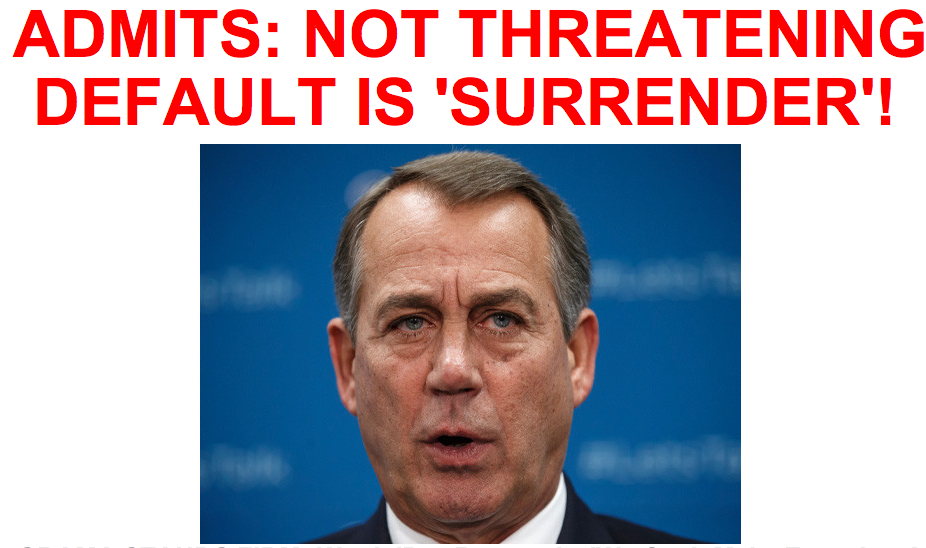
WASHINGTON — Less than two hours after President Barack Obama turned up political pressure on Republicans to reopen the government and raise the debt ceiling, House Speaker John Boehner (R-Ohio) said the president was looking for “unconditional surrender.”
“The president said today if there’s unconditional surrender by Republicans, he’ll sit down and talk to us,” Boehner said Tuesday. “That’s not the way our government works.”
The Ohio Republican addressed reporters just outside his office to rebut Obama’s earlier press conference. His message to the president was clear: The ongoing government shutdown and pending debt ceiling deadline would not be resolved without negotiations.
“It’s time to have that conversation,” Boehner said. “Not next week, not next month — the conversation needs to begin today. The long and short of it is, there’s going to be a negotiation.”
Boehner ducked a question on what would happen if Congress found itself in the final minutes before a debt ceiling breach without an agreement, reiterating the need to talk.
Obama placed a call to Boehner earlier in the day, to reaffirm his position that Republicans should pass ‘clean’ bills, with no strings attached, to end the government shutdown and to increase the debt ceiling. Boehner said it was a “pleasant” conversation, but he was left “disappointed.”
House Republicans unveiled a new strategy Tuesday to deal with both the shutdown and the looming debt ceiling crisis: a bipartisan negotiating team, resembling 2011’s supercommittee, that would hash out a deal to solve both issues. Senate Democrats showed little interest in the idea, and plan to bring a clean bill to the floor this week that would extend the debt limit through the end of 2014.
Sponsored Links
“All we’re asking for is to sit down and have a conversation,” Boehner said. “There’s no reason to make it more difficult to bring people to the table. There’s no boundaries here. There’s nothing on the table, there’s nothing off the table. I’m trying to do everything I can to bring people together and have a conversation.”
Both Obama and Democrats said they would be willing to have that conversation, but only after Republicans reopen the government and raise the debt ceiling. Rep. Chris Van Hollen (D-Md.), the House Budget Committee’s top Democrat, also pointed out that Republicans did not include tax reform in the so-called negotiating team’s points of discussion, making the prospects of a deficit-reduction deal unlikely.
If no breakthrough is made in the next week, Congress will move dangerously close to the Oct. 17 deadline for the government to breach the current debt limit. Economists have warned the consequences of default may include sending stock and bond markets into nosedives and tipping off another recession.
Boehner said he agreed with the president that the consequences of default would be severe.
“I didn’t come here to shut down the government,” Boehner said. “And I certainly didn’t come here to default on our debt.”

Continuing our CSN focus for this week I have a wonderful treat for you today…..a recent video of David Crosby singing Joni Mitchell’s For Free during a photo shoot. This is really good stuff……
Since it’s Two’Fer Tuesday here is a great video of Joni singing For Free on BBC from 1970.

The Republican Right Wing Extremist Tea Party continues to hold the US Government hostage. Looking like this could go on a while with the House crazies looking to link raising the Debt Ceiling to Obamacare. First up today a little humor. Following that is a great article from Business Week highlighting the likely impacts of the Tea Party forcing the US into defaulting on its debt. Really scary stuff!

Anyone who remembers the collapse of Lehman Brothers Holdings Inc. little more than five years ago knows what a global financial disaster is. A U.S. government default, just weeks away if Congress fails to raise the debt ceiling as it now threatens to do, will be an economic calamity like none the world has ever seen.
Failure by the world’s largest borrower to pay its debt — unprecedented in modern history — will devastate stock markets from Brazil to Zurich, halt a $5 trillion lending mechanism for investors who rely on Treasuries, blow up borrowing costs for billions of people and companies, ravage the dollar and throw the U.S. and world economies into a recession that probably would become a depression. Among the dozens of money managers, economists, bankers, traders and former government officials interviewed for this story, few view a U.S. default as anything but a financial apocalypse.
The $12 trillion of outstanding government debt is 23 times the $517 billion Lehman owed when it filed for bankruptcy on Sept. 15, 2008. As politicians butt heads over raising the debt ceiling, executives from Berkshire Hathaway Inc.’s Warren Buffett to Goldman Sachs Group Inc.’s Lloyd C. Blankfein have warned that going over the edge would be catastrophic.
Lehman Aftermath
“If it were to occur — and it’s a big if — one would expect a series of legal triggers, potentially transmitting the default to many other markets,” said Mohamed El-Erian, chief executive officer of Pacific Investment Management Co., the world’s largest fixed-income manager. “All this would add to the headwinds facing economic growth. It would also undermine the role of the U.S. in the world economy.”
The U.S. stock market lost almost half its value in the five months following Lehman’s failure. The country had its worst recession since the Great Depression (INDU), taking the global economy down with it. Unemployment (USURTOT) surged to 10 percent, the highest in three decades.
Another depression was prevented only by unprecedented action by the Federal Reserve, which pumped $3 trillion into the financial system. The U.S. Treasury provided about $300 billion of capital for the nation’s banks.
“If we miss an interest payment, that would blow Lehman out of the water,” said Tim Bitsberger, a former Treasury official under President George W. Bush and now a New York-based managing director at BNP Paribas SA. “Lehman was an isolated company, and now we are talking about the U.S. government.”
‘Nuclear Bombs’
Buffett has asked politicians to stop using the debt limit as a weapon in policy debates. Morgan Stanley CEO James Gorman urged employees to contact their congressmen to remind them about the “unacceptable consequences” of a default.
“It should be like nuclear bombs, basically too horrible to use,” Buffett, 83, said in an interview published by Fortune magazine last week.
The yield on 10-year U.S. bonds dropped to a two-month low of 2.58 percent on Oct. 3. It was 2.61 percent at 10:25 a.m. in New York trading today. While short-term bill rates and the cost to insure against a default have risen, volatility in Treasuries has fallen, a sign that investor confidence in the Fed’s bond-purchase program is outweighing worries over the budget battle.
Bond prices didn’t foretell Lehman’s default either. Ten days before the bankruptcy, Lehman bonds were trading at about 95 cents on the dollar, the same level as JPMorgan Chase & Co. debt at the time.
‘Holy Cripes’
One unexpected consequence of Lehman’s collapse was the seizing up of the repurchase agreement, or repo, market — a form of secured, short-term borrowing used by Wall Street banks and investment firms. Many of Lehman’s trading counterparts discovered the collateral they believed was backing their loans wasn’t there to grab as rules allowed. That scared investors in the rest of the market, closing off other trades and leading to fire sales of securities and further price declines.
A government default could freeze the repo market more than Lehman’s collapse because U.S. debt forms its backbone. At least $2.8 trillion of Treasuries serve as collateral for repo and reverse-repo loans, according to Fed data.
In the event of a default, Treasuries might no longer be eligible as collateral for repo agreements, according to James Kochan, Wells Fargo Funds Management LLC’s chief fixed-income strategist. The cheap funding for the holdings lowers the yields demanded on the investments, and unwinding the positions could amplify losses for lenders and borrowers.
If Treasuries were ejected from the market, “Well, holy cripes,” Kochan said in an interview.
Congressional Gridlock
In 2011, the last time Congress was gridlocked over the extension of the debt ceiling, repo rates rose as money-market funds pulled back because they didn’t want the risk of holding a security in default.
“A lot of this is about fear of the unknown,” said Scott Skyrm, a former head of repo and money markets for Newedge USA LLC and author of “The Money Noose: Jon Corzine and the Collapse of MF Global.” “There is no upside to being in the market in that environment, so people pull out.”
The U.S. didn’t default on its debt in 2011. Republicans and Democrats reached a last-minute deal to raise the borrowing limit. Even so, the posturing hurt consumer confidence and wiped out $6 trillion of value from global stocks.
Historical Lessons
While none of the people interviewed for this story expect the world’s largest economy to default this time either, most say the chances of it happening now are higher than in the past.
“It would be insane to default, but it’s no longer a zero-percent probability,” said Simon Johnson, a former chief economist of the International Monetary Fund who teaches economics at the Massachusetts Institute of Technology and is a columnist for Bloomberg View.
The U.S. hasn’t defaulted since 1790, when the newly formed nation deferred until 1801 interest obligations on debt it assumed from the states, according to “This Time Is Different,” a history of financial crises by Carmen Reinhart and Kenneth Rogoff.
In 1933, the U.S. refused to make payments in gold to redeem bonds that gave holders the option of requesting the precious metal instead of cash. While investors were paid on time and in full, some argued it was a default because they couldn’t claim payment in gold. The Supreme Court ruled that the government was within its rights to deny such claims as long as it paid the dollar amounts.
Technical Default
In 1979, the U.S. was late to make payments on about $122 million of bills, in part because of “severe technical difficulties” that the Treasury said stemmed from a word-processing failure, according to the Financial Review’s August 1989 issue. While payments were made after a short delay, including with interest for tardiness, the hiccup caused yields to rise by half a percentage point and stay there for months.
A default today could be deemed “technical” because it would be the result of the government’s unwillingness to pay, not its ability, JPMorgan analysts including Alex Roever said in a report last week.
In a technical default, only the prices of Treasury bonds that mature or have coupon payments would fall, according to the analysts. Money-market funds wouldn’t be forced to sell government bonds, and the Fed probably would continue accepting them as collateral for emergency cash.
That distinction is nothing more than an effort to downplay the danger of default, according to MIT’s Johnson. Sovereign defaults are always about the political will to pay because most governments can print money to make payments if they want to, Johnson said.
Insufficient Funds
Labeled technical or not, a default is still a default, said Jim Grant, founder of Grant’s Interest Rate Observer.
“People have typically turned to Treasuries as a safe haven, but what will happen when they realize it’s not safe anymore,” said Grant, who has followed interest rates since the 1970s. “Financial markets are all confidence-based. If that confidence is shaken, you have disaster.”
Treasury Secretary Jacob J. Lew has said the government will have only $30 billion of cash left by Oct. 17 to meet its commitments. Those can run as high as $60 billion a day, which means the Treasury will need to borrow more to meet its liabilities, Lew said. Goldman Sachs expects the Treasury’s cash balance to be depleted by Oct. 31 and “possibly quite a bit sooner,” analysts at the bank wrote in an Oct. 5 report.
Borrowing Costs
The Treasury has $120 billion of short-term bonds coming due on Oct. 17, according to data compiled by Bloomberg. An additional $93 billion of bills are due on Oct. 24. On the last day of the month, $150 billion needs to be paid back, including two-year and five-year notes that mature. The total due from Oct. 17 through Nov. 7 is $417 billion.
While some expect a 2013 default will drive up yields only on Treasury securities coming due, others including former Deputy Treasury Secretary Roger Altman see a wider impact in bond yields, pushing up borrowing costs.
“That would be higher interest costs over some considerable period of time for the U.S. and for U.S. taxpayers,” said Altman, who’s chairman of New York-based investment bank Evercore Partners Inc.
Some point to Standard & Poor’s 2011 downgrade of the U.S. credit rating, which led to an increase in Treasury prices, not a drop. Even after the rating was lowered by one level to AA+ from AAA, investors continued buying U.S. government bonds as they flocked to safety, according to Joe Davis, chief economist at Vanguard Group Inc.
Disappearing Liquidity
A downgrade to default rating would be different, said Peter Tchir, founder of New York-based TF Market Advisors. Investors, structured vehicles, collateral agreements, derivatives contracts and other trading covenants have ratings-based rules that could force the replacement of Treasuries in a trade or portfolio, he said.
“Once the system starts to break down related to settlement and payments, then liquidity disappears, as we saw after Lehman,” Tchir said. “Perhaps the things we’re worried about now will be fine after a U.S. default, but who knows what others will not be.”
Treasuries are among the most popular forms of collateral pledged at derivatives clearinghouses, including the one owned byCME Group Inc. (CME:US), the world’s largest futures market. Government agencies such as Freddie Mac and Fannie Mae, which use interest-rate swaps and derivatives to hedge mortgage portfolios, would be affected by a downgrade because it could lower their counterparty ratings and result in more collateral being demanded by trading partners.
‘Create Chaos’
“We can’t even imagine all the things that might happen, just like Henry Paulson couldn’t imagine all the bad things that might happen if he let Lehman go down,” said Bill Isaac, chairman of Cincinnati-based Fifth Third Bancorp and a former chairman of the Federal Deposit Insurance Corp., referring to the former U.S. Treasury secretary. “It would create chaos in financial markets.”
Higher borrowing costs could slow the housing recovery. If 30-year mortgage rates climbed to 6.5 percent from 4.5 percent, a borrower who can now afford the monthly payment on a $200,000 loan would only be able to take on about $160,000 of debt when buying a property, forcing down sale prices.
It would be “bad — both for affordability and for consumer confidence,” said Jed Kolko, chief economist for Trulia Inc., an online property-listing service.
Banks would have to write down securities on their books that are losing value and face capital shortfalls, according to MIT’s Johnson.
“The government wouldn’t have the cash to rescue the banks this time either,” Johnson said.
China, Japan
About half of the U.S. debt is held by foreign governments, central banks and other overseas investors, according to Treasury data. A default would throw those holdings into question as well as the dollar’s status as the world’s reserve currency, Johnson said. During the 2011 debt-ceiling scare, foreign investors shunned Treasury auctions for about three months, according to data compiled by JPMorgan.
China is the largest holder of U.S. Treasuries, with $1.3 trillion in July, according to Treasury data. Japan follows with $1.1 trillion.
Even if Treasury prices aren’t affected by a default, the damage in other markets could be devastating. U.S. stocks fell 7 percent in one day when Congress rejected the government’s bank-rescue package in 2008, before passing it a few days later.
Market Shocks
The market shocks would be enough to tip the U.S. back into recession and drag the world economy down, according to Desmond Lachman, a fellow at the Washington-based American Enterprise Institute. The event could prove to be the trigger that reverses a weak and fragile recovery, said William Cunningham, head of credit portfolios for the investment arm of Columbus, Ohio-based Nationwide Mutual Insurance Co. Lehman’s collapse was a similar spark, he said.
“Is this the straw among other things that tips an economy without drivers of growth back down into a negative spiral?” Cunningham said.
While a short-lived default might be fixed without major damage to the global economy, drawing a line between short and long isn’t easy, according to Evercore’s Altman.
“If you missed an interest payment by two hours, the markets might look entirely beyond that and forgive you,” Altman said. “If you miss an interest payment by two days, four days, six days, that’s a different story. It’s very difficult to be scientific about this.”
‘Flying Blind’
During the final days of Lehman Brothers, Wall Street firms set up war rooms to chart the potential impact of the firm’s demise and prepare strategies to cope with the consequences. Their scenarios, which focused on credit-default swaps, didn’t forecast the contagion that quickly spread after the bankruptcy.
Now, some banks are preparing contingency plans for a possible U.S. default, such as stocking retail branches with more cash, the New York Times reported last week. Those preparations might prove useless once again.
“Nobody knows what would happen if there were a default because the reality is there’s never been even a technical default in the U.S.,” said Russ Koesterich, chief investment strategist at BlackRock Inc., the world’s largest asset manager. “Everyone’s flying blind.”

Here’s a an interesting TV profile of Crosby, Stills, and Nash from 1987. It’s brutal but very interesting at the same time. You might want to look away but I suggest you watch………

The Republican Right Wing Extremist Tea Party continues to hold the US Government hostage. Looking like this could go on a while with the House crazies looking to link raising the Debt Ceiling to Obamacare. First up today a little humor. Following that is a TV advertisement that ran yesterday and captures the essence of what is going on in the House of Representatives!
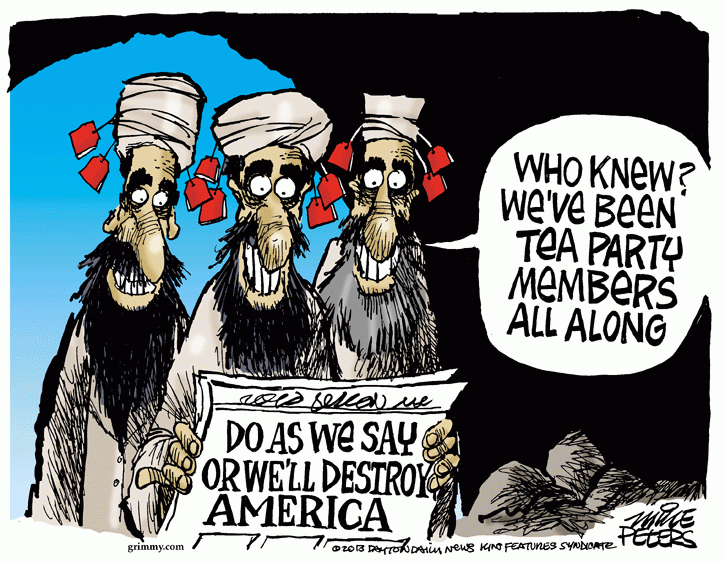
I think you will like this…….
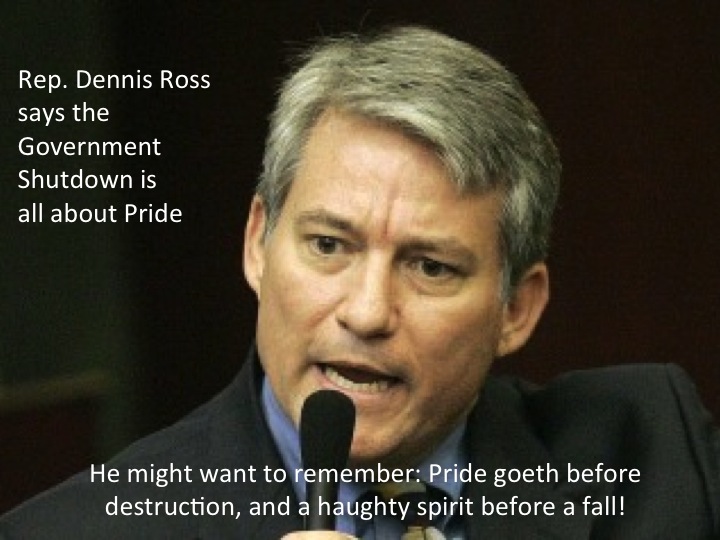
So the latest from the Republican party, by way of Dennis Ross, is that the shutdown of the US Government, and dance with the devil threat to allow the US to default on its debt, is now all about Pride. Read all about it in this article from Huffington Post.
WASHINGTON — With the government shutdown in its fifth day, many Republicans have conceded the fight is no longer about Obamacare. Rep. Dennis Ross (R-Fla.) added his name to the list on Saturday, saying the matter now boils down to “pride.”
“Republicans have to realize how many significant gains we’ve made over the last three years, and we have, not only in cutting spending but in really turning the tide on other things,” Ross told The New York Times. “We can’t lose all that when there’s no connection now between the shutdown and the funding of Obamacare.”
“I think now it’s a lot about pride,” he added.
The fight over keeping the government open began with Republicans insisting that any funding bill include anti-Obamacare provisions, starting with a full-fledged campaign led by Sen. Ted Cruz (R-Texas) to defund the health care law. When that plan was rejected by the Senate, House Republicans offered a series of spending bills that continued to chip away at Obamacare; their final offer included a one-year delay of the law’s individual mandate and a ban on federal health care subsidies to members of Congress and their staffs.
Ross told Bloomberg that Republicans had “lost the [continuing resolution] battle.”
“We need to move on and take whatever we can find in the debt limit,” he said.
But many of his colleagues, particularly in the House GOP’s right flank, have refused to back down. Comments made by Rep. Marlin Stutzman (R-Ind.) last week underscore Ross’ suggestion that many Republicans believe what’s at stake is no longer a matter of policy but one of pride.
“We’re not going to be disrespected … We have to get something out of this. And I don’t know what that even is,” Stutzman said.
The Indiana Republican later apologized, saying he had “carelessly misrepresented” the budget debate.
House Republicans have pushed a series of targeted spending bills to fund parts of the government, notably those that have received the most attention, such as the National Institutes of Health, Veterans Affairs, and parks and museums. The White House and Senate Democrats have rejected the piecemeal approach, pointing out that House Speaker John Boehner (R-Ohio) has the votes to reopen the entire government.

This Crosby, Stills & Nash’s The Acoustic Concert was taped at a 1991 show in San Francisco that was done as a memorial for Bill Graham. The boys were still in good voice……I think you will enjoy this one!
If you like CSN, you need to come back often this week. We will feature the group, collectively and individually, throughout the week.
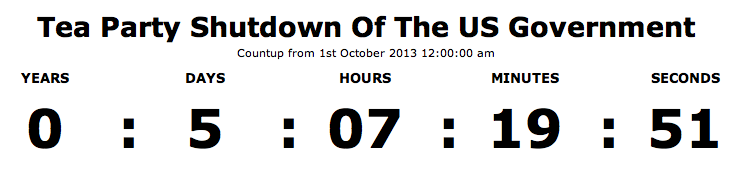
The Republican Right Wing Extremist Tea Party continues to hold the US Government hostage. Looking like this could go on a while.
Today I want to address why I am taking so much time addressing United States politics in a music blog. The bottom line is that in the United States we have small group of right wing extremist that are trying to fundamentally change our way of government. These people want to impose their political, and religious, beliefs on everyone in the United States and they are willing to ignore the rule of law to do so. I consider this to be a serious attack and feel that it is my duty as an involved US citizen to do whatever I can to fight it. This blog is my weapon.
I have always been very inspired by the poem, To Italy, by Giacomo Leopardi. My favorite section of the poem goes something like this and hopefully helps to explain what I was trying to express above:
How hast thou fallen from thy pride of place to this abyss of misery!
Are there none to combat for thee, to defend thy cause?
To arms!
Alone I’ll fight and fall for thee!
Content that if my best blood strike forth one spark
To fire the bosoms of my countrymen
If you aren’t familiar with the work of Giacomo I strongly suggest that you check him out, he is widely regarded as the greatest Italian poet of the 19th century!

Today I want to introduce you to four groups that are making some great music: The Front Bottoms are an indie-punk band out of New Jersey; Lowland Hum is a husband and wife folk duo out of North Carolina; Volcano Choir is an indie band out of Wisconsin that features Bon Iver’s Justin Vernon; and Lily and Madeline (pictured above) are a pair of teenaged sisters with unbelievable songs and vocal harmonies. I think you will enjoy the songs I have chosen to feature from each of these groups. With a little searching on internet you should be able to find addition music for any of these groups that catches your interest.
The Front Bottoms – Au Revoir
Lowland Hum – How Long
Volcano Choir – Byegone
Lily and Madeline


 thebestmusicyouhaveneverheard