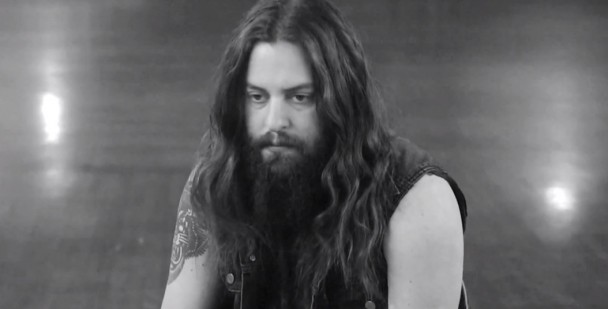
This is the fourth in my series of posts about Tribute Songs. Today’s song, JM, by Strand Of Oaks (Timothy Showalter) hit me like a punch in the gut when I first heard it last week. Let’s listen and then I will provide you with more details about the song and who it’s a tribute for…..
JM will be featured on the Strand of Oaks album Heal that is scheduled to be released on June 24. The JM in the song is Jason Molina and I have to confess that he was not on music radar when he died last year. When I heard Timothy Showalter’s awesome tribute to his hero I knew that I had to learn more about Jason and his music.
I’ve spent the last week or so listening to the the catalog of music that Jason left behind when he died and I’m blown away. Be looking for a post about Jason in the near future. In the meantime, you won’t go wrong checking out Jason’s music for yourself. FYI – Jason recorded under his own name, under Magnolia Electric Company, and under Songs: Ohia.
Did anyone else notice the similarity of JM to Cortez the Killer by Neil Young? Here’s a great live performance of Cortez so you can see what I mean.
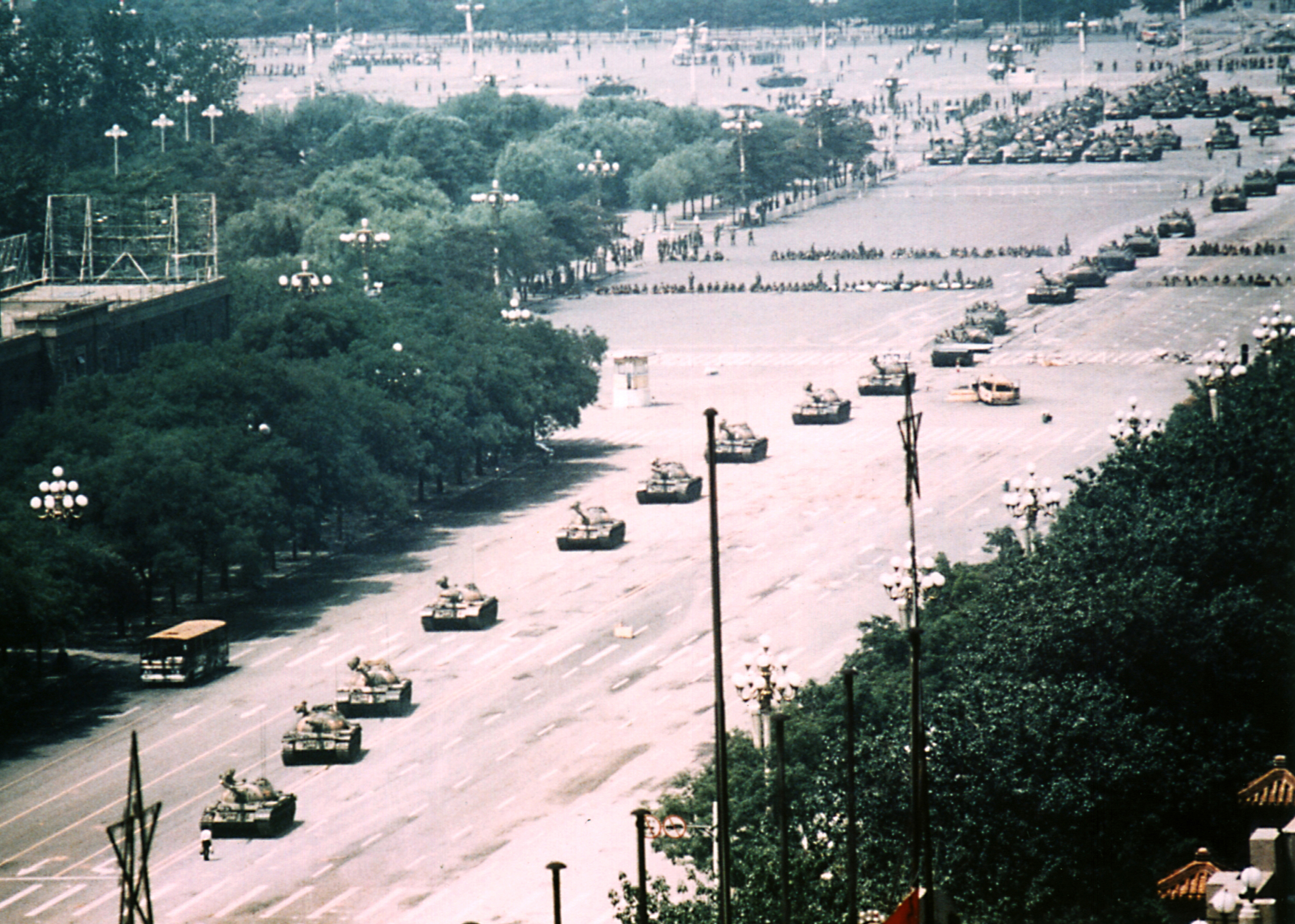
Twenty five years ago, Chinese authorities brutally suppressed the student-led Democracy Movement in Tiananmen Square. Troops backed by tanks massacred an unknown number of unarmed Chinese citizens that were attempting to block the advance of the military to Tiananmen Square. The photo above is a zoomed out view of a student blocking a column of advancing tanks armed with nothing but a briefcase. If you ever doubt that you can make a difference in the world pull this picture out to remind yourself just how much one person can accomplish.
Mary Chapin Carpenter wrote a great song about the Massacre, 4 June 1989. The story behind the song is summarized in the following extract from an August 26, 2010 article posted on the Washington Post website. Read the article and then listen to the song below.
It was [inspired by] an article in the New York Times during the 20th anniversary week of the Tiananmen Square massacre. It was a profile of an artist in China who was 17 at the time, and he was a soldier in the army. The first verse is his recollections of what it was like to be there — and to be sent in “imposter’s clothes,” when the authorities were trying to infiltrate the protesters. He was haunted by his part in it. He’s an artist now in China and he works all the time trying in a way to almost provoke the authorities. They have this game that they play where they allow him to put his work on the Internet for example, and it’ll stay up for a day or two, and then all of a sudden it’s taken down. The lyric about “vanishing into the ether” is my sense of it. His story was exceedingly moving to me and I just tried to write about it.
When I started this blog two and a half years ago I envisioned that it would be a journey where I mostly walked alone. I’m happy to say that this was not the case! I’ve had visitors from over 148 countries around the world as part of over 50,000 views of the 700 posts that I have made so far. I’ve met, and become friends with, people around the world! I would like to single out Gerard from the Netherlands who has been a supporter of this blog almost from day one and who has encouraged me to continue to post via his frequent comments. Unbelievable!
The map shown above shows the countries that the blog has been visited from….the darker the color for a country the more visits I’ve had from it. In case you are interested, the countries that HAVE NOT visited this blog include:
The Americas
Cuba
Guyana
Suriname
French Guiana
Africa
Western Sahara
Mauritiania
Guinea
Sierra Leone
Liberia
Mali
Burkina Faso
Cote D’Ivore
Ghana
Benin
Niger
Chad
Gabon
Congo
Sudan
South Sudan
Uganda
Tamzania
Malawi
Eritrea
Dijbouti
Somalia
Madagascar
Central African Republic
Middle East
Yemen
Iran
Asia
Turkmenistan
Tajikistan
North Korea
Other
Greenland
Svalbard
I can’t tell you how much I appreciate everyone around the world that has visited this blog. Thanks to each of you for walking with me on a least a portion of this musical journey through time. Please listen to “Walk With Me” by Neil Young as an expression of my thanks to you!
I feel your love
I feel your strong love
I feel the patience
Of unconditional love
I feel the strength
I feel your faith in me
I’ll never let you down
No matter what you do
If you just walk with me
And let me walk with you
I’m on this journey
I don’t wanna walk alone
Walk with me
Walk with me
Walk with me
Walk with me
Walk with me
Shine me a light
Walk with me
Walk with me
I lost some people
I was traveling with
I missed a soul
And the old friendship
In 1970 James Taylor was just starting his solo career. He recorded a live BBC special acoustic performance that’s one of my favorite James Taylor performances. During that performance he played a great version of my favorite James Taylor song, Riding On A Railroad. Let’s listen to that performance……..
Over forty years later, James is still one of our best singer/songwriters and still regularly tours. In forty years he hasn’t lost a thing….except for most of his hair 🙂 To prove it, here’s a great performance of Riding On A Railroad from a 2012 show at the White House.
There was an interesting article in yesterday’s Wall Street Journal, The Guitar Riff That Changed Rock ‘n’ Roll, that transported me back in time to the day I first heard Whole Lotta Love, a song that absolutely blew my mind. The article, written by Marc Meyers, is great but it’s also mis-titled. The focus of the article is more on the recording of the song than on the amazing opening riff which is fine with me because it was the way the song was recorded that blew my mind! Before I tell you about the article let me tell you about the first time I heard Whole Lotta Love.
In 1970, the only stereo record player that my family had was an old console model. Most people that read this probably don’t know what that is so I’ve included a picture below to show what one looked like.
It was basically a piece piece of furniture that contained a turntable for records and two speakers. My family’s stereo sat in the family living room so I had a narrow window of opportunity to play my music each day. I could listen when I got home from school at 3:30 while my mom was busy making dinner. I had to stop listening around 5:00 before my dad got home from work. My parents were very conservative so even when I could use the stereo to listen to my records I had to keep the volume level very low (our stereo didn’t have a head phone jack and it didn’t really matter because I didn’t have headphones!)
So picture this….I’ve just managed to get my hands on a copy of Led Zeppelin II and I’m getting ready to listen to it in my living room. I’m sitting right in front of the stereo so I can hear it without having the volume cranked up, the album drops onto the turntable, I hear the turntable arm start moving, and then it’s on the album.
BOOM!
There’s the hint of weird little chuckle, Jimmy rips into the most amazing riff I’ve ever heard, and there’s an amazing bass line. As Robert Plant starts to sing it’s like he has positioned himself squarely in front of me singing the hell out of the song. But there’s something else going on here ….Jimmy’s guitar licks seem to start in one speaker and end in the other one. Very cool but that was just the start of the coolness! About a minute and a half into the song…….there’s a breakdown and all hell breaks loose as the song degenerates into a very strange cacophony of sounds (drums, cymbals, vocals snippets, and others that I couldn’t place) that seemingly bouncing from side to side. By this time I was freaking out yet somehow I knew that I was missing the full affect without headphones. The rest of the song was just as amazing but I knew I absolutely had to hear it again with headphones.
I had a friend with headphones and I immediately headed to his house (two streets over from where I lived). Soon I was sitting in front of his family’s stereo system, headphone on, with Whole Lotta Love blasting away, and my mind was immediately blown!. Jimmy’s guitar, and the other strange sounds on the record, were shooting right through my head and at times bouncing around in there. It was amazing and changed my whole perception about what music could be. My friend wasn’t a rock fan but even he had to admit that the the song was pretty cool when listened to with headphones.
The article in The Wall Street Journal last Friday that brought back all of these memories helped me finally understand how/why the sounds in in Whole Lotta Love were created. Here’s an excerpt from the article that focuses on that part of the story…..
Eddie Kramer: The first time I heard “Whole Lotta Love” was in August ’69, when Jimmy and I started working on the album’s final mix at New York’s A&R Sound.
Jimmy and I had first met in 1964, when he was playing on the Kinks’ first album [“Kinks”] at Pye Studios and I was the assistant engineer. I also had heard Led Zeppelin early on in ’68, when John Paul Jones had played me an acetate of Led Zeppelin’s first album, before it was released. I was blown away—it sounded so hard and heavy.
In New York, the recording console at A&R was fairly primitive. It had only 12 channels with old-fashioned rotary dials to control track levels instead of sliding faders and there were just two pan pots [control knobs] to send the sound from left to right channels. But as Jimmy and I listened to the mix, something unexpected came up.
At the point where the song breaks and Robert slowly wails, “Way down inside…wo-man…you need…love,” Jimmy and I heard this faint voice singing the lyric before Robert did on the master vocal track. Apparently Robert had done two different vocals, recording them on two different tracks. Even when I turned the volume down all the way on the track we didn’t want, his powerful voice was bleeding through the console and onto the master.
Some people today still think the faint voice was a pre-echo that we added on purpose for effect. It wasn’t—it was an accident. Once Jimmy and I realized we had to live with it on the master, I looked at Jimmy, he looked at me and we both reached for the reverb knob at the same time and cracked up laughing. Our instincts were the same—to douse the faint, intruding voice in reverb so it sounded part of the master plan.
Mr. Page: I hadn’t heard anything like that before and loved it. I was always looking for things like that when I recorded. That’s the beauty of old recording equipment. Robert’s faraway voice sounded otherworldly, like a spirit anticipating the vocal he was about to deliver.
Mr. Kramer: By adding reverb, we made his faint voice more dynamic, and it became part of rock history. I also used the pan pots on Jimmy’s guitar solo to fling it from side to side, so it would move from one speaker to another. I loved the sonic imagery and I like to think of my mixes as stereophonic paintings.
On the break after the first chorus, where the song gets quiet and we hear Bonzo’s cymbals and percussion and Jimmy’s distortion, Jimmy and I went nuts on the knobs. We had eight dials controlling the levels on eight individual tracks, so we rehearsed the choreography of what we were going to do to create the far-out sounds. Then we did it and printed the result onto the master stereo reel. Because Jimmy was a studio brat, he really understood how we could push the limits. When you have limitations in the studio, you go for it and stretch your imagination.
The remainder of the article is just as interesting and you can read the whole thing at the following link:
If you read any of my three Memorial Day posts you will recall that, while I honored our veterans that died serving our country, I also called for greater restraint in the use of our military forces in the future. Today, two days after my posts, President Obama gave a major foreign policy speech at West Point Military Academy that argues for exactly the same policy that I called for. I don’t believe in coincidence so maybe President Obama reads this blog (I know for a fact that he is a big music fan)……or maybe it’s just that great minds think alike 🙂 Either way, I proud to have him as our President.
Here’s a great article from the Huffington Post about his speech if you are interested in the details.
WEST POINT, N.Y. (AP) — In a broad defense of his foreign policy, President Barack Obama declared Wednesday that the U.S. remains the world’s most indispensable nation, even after a “long season of war,” but argued for restraint before embarking on more military adventures.
Standing before the newest class of officers graduating from the U.S. Military Academy, Obama said, “I would betray my duty to you, and to the country we love, if I sent you into harm’s way simply because I saw a problem somewhere in the world that needed fixing, or because I was worried about critics who think military intervention is the only way for America to avoid looking weak.”
Obama’s speech signaled a concerted effort by the White House to push back against those critics, who contend that the president’s approach to global problems has been too cautious and has emboldened adversaries in Syria, Russia and China. It’s a criticism that deeply frustrates the president and his advisers, who say Obama’s efforts to keep the U.S. out of more military conflicts are in line with the views of the American public.
Even as the U.S. emerges from the two wars that followed the Sept. 11, 2001, attacks, Obama said terrorism remains the most direct threat to American security. But he argued that as the threat has shifted from a centralized al-Qaida to an array of affiliates, the American response must change too.
Rather than launching large-scale military efforts, Obama called for partnering with countries where terrorist networks seek a foothold. That effort includes a new $5 billion fund to help countries fight terrorism and to expand funding for Defense Department intelligence, surveillance, reconnaissance, special operations and other activities.
Obama cast the bloody civil war in Syria as more of counterterrorism challenge than a humanitarian crisis. He defended his decision to keep the U.S. military out of the conflict but said he would seek to increase support for the Syrian opposition, as well as neighboring countries including Jordan, Lebanon, Turkey and Iraq that have faced an influx of refugees and fear the spread of terrorism.
“In helping those who fight for the right of all Syrians to choose their own future, we also push back against the growing number of extremists who find safe haven in the chaos,” Obama said.One plan being considered by the White House is a project to train and equip members of the Free Syrian Army on tactics, including counterterrorism.
The president’s speech came one day after he outlined plans to wind down America’s lengthy war in Afghanistan by the end of 2016. The blueprint calls for keeping 9,800 troops in Afghanistan for training and counterterrorism even after combat missions end later this year, but then withdraw them within two years.
The drawdown plan is central to Obama’s long-standing pledge to bring to a close both the Afghan conflict and the Iraq war, which ended in late 2011. He was greeted by cheers from the graduating cadets when he noted that they had the distinction of being “the first class to graduate since 9/11 who may not be sent into combat in Iraq or Afghanistan.”
Even as he heralded the end of those two wars, Obama said the U.S. would continue to use military force on its own “when our core interests demand it — when our people are threatened, when our livelihood is at stake, or when the security of our allies is in danger.” He also continued to defend his use of drone strikes in places like Yemen and Somalia but called for increased transparency about the program that has long been shrouded in secrecy.
But a centerpiece of Obama’s address was a defense of his preference for acting as part of an international coalition instead of pressing ahead alone. He challenged skeptics who see that approach as a sign of weakness and argued instead that it instead highlights America’s ability to lead on the world stage.
Obama cited recent efforts to rally European support for sanctions against Russia after the Kremlin annexed the Crimean Peninsula from Ukraine. While the president insisted that Russia is now isolated, Obama’s critics contend that his inability to stop Russian President Vladimir Putin from taking Crimea in the first place was a sign of weakness.
Obama also praised ongoing diplomatic efforts between Iran, the U.S. and its negotiating partners — Germany, Britain, France, China and Russia — that aim to strip the Islamic republic of its nuclear capabilities. While Obama said the odds of reaching an agreement are still long, he also said a diplomatic breakthrough would be “more effective and durable than what would be achieved through the use of force.”
“Throughout these negotiations, it has been our willingness to work through multilateral channels that kept the world on our side,” he said.
Days like today make me even more proud to be an American than normal. To celebrate let’s listen to a wonder rendition of My Country Tis Of Thee by David Crosby and Graham Nash…..
This week’s special performance is a great concert featuring James Taylor and the Dixie Chicks singing each others songs. This is a magical combination that makes for some beautiful, unexpected, musical performances and some interesting backstage discussions. I’m betting that you will enjoy this as much as I do…….
This performance is bittersweet having taken place before conservatives (think Rush Limbaugh and others of his ilk) destroyed the Dixie Chick’s career because they said: “Just so you know, we’re ashamed the president of the United States is from Texas.” during the run up to the Iraq war. Today, these very same conservatives daily say the most vile lies about, and use the ugliest slurs that you can imagine to describe, President Obama. Their level of hypocrisy is unmatched in US history.
I’ve been paying more time looking at analytics data for this blog (i.e. I’ve been paying attention to how many people have visited the blog and what country they are visiting from). I was shocked to note that no one from Greenland has ever visited the blog. I did a little research and discovered that Greenland has an active music scene so I decided to use this week’s Two’fer Tuesday post to highlight a couple of artists from Greenland. My hope is that the post might attract some visitors from that country (if you know anyone that lives in Greenland encourage them to come and visit.
Today’s post highlights a group named Malik and a second group, picture above, named Nanook. I enjoyed both of their songs and hope that you will as well (I don’t speak Greenlandic so I really don’t know what the songs are about). If someone from Greenland visits the blog maybe they will provide us with translations! Let me know what you think……..
Malik – ilumooruma soqutaanngilaq
Nanook – Kisimiinneq – Seqinitta qinngorpaatit
As a bonus here’s a video from Nanook’s 2012 summer tour of the Faroe Islands. It looks like the boys had some travel challenges getting to the Islands but, once there, everyone seemed to have a great time!
Nanook summer tour 2012, Faroe Islands
I did a little research on the Faroe Islands and have decided that I need to visit them myself. They are absolutely beautiful as you can tell from the picture below!
This is Memorial Day weekend in the US. A time when we remember and honor the men and women who have fought and died for our country. This is the second of three posts I have planned for this weekend, each of which will include a D-Day article written by war correspondent Ernie Pyle. Ernie was there and if you read his words you’ll find yourself transported there as well.
Ernie’s words give me chills and I try to read them every year to honor those that he was writing about. My uncle, Herman Rice, was one of the paratroopers that was dropped behind the German forces the day prior to D-Day to support the invasion and I can’t think of any better way to honor his memory.
As we remember those that have fought for our country I believe that it’s important to also spend some time thinking about the importance of working just as hard to avoid wars as we do to fight wars. I love my country but some of our leaders in the past have chosen to get us involved in wars that we had no business being involved in. Think Vietnam, Iraq, etc. etc. etc. Let’s use Memorial Day to commit ourselves to not making such mistakes in the future!
Here is the last of Ernie’s three D-Day articles, A Long Thin Line Of Personal Anguish,……
NORMANDY BEACHHEAD, June 17, 1944 – In the preceding column we told about the D-day wreckage among our machines of war that were expended in taking one of the Normandy beaches.
But there is another and more human litter. It extends in a thin little line, just like a high-water mark, for miles along the beach. This is the strewn personal gear, gear that will never be needed again, of those who fought and died to give us our entrance into Europe.
Here in a jumbled row for mile on mile are soldiers’ packs. Here are socks and shoe polish, sewing kits, diaries, Bibles and hand grenades. Here are the latest letters from home, with the address on each one neatly razored out – one of the security precautions enforced before the boys embarked.
Here are toothbrushes and razors, and snapshots of families back home staring up at you from the sand. Here are pocketbooks, metal mirrors, extra trousers, and bloody, abandoned shoes. Here are broken-handled shovels, and portable radios smashed almost beyond recognition, and mine detectors twisted and ruined.
Here are torn pistol belts and canvas water buckets, first-aid kits and jumbled heaps of lifebelts. I picked up a pocket Bible with a soldier’s name in it, and put it in my jacket. I carried it half a mile or so and then put it back down on the beach. I don’t know why I picked it up, or why I put it back down.
Soldiers carry strange things ashore with them. In every invasion you’ll find at least one soldier hitting the beach at H-hour with a banjo slung over his shoulder. The most ironic piece of equipment marking our beach – this beach of first despair, then victory – is a tennis racket that some soldier had brought along. It lies lonesomely on the sand, clamped in its rack, not a string broken.
Two of the most dominant items in the beach refuse are cigarets and writing paper. Each soldier was issued a carton of cigarets just before he started. Today these cartons by the thousand, water-soaked and spilled out, mark the line of our first savage blow.
Writing paper and air-mail envelopes come second. The boys had intended to do a lot of writing in France. Letters that would have filled those blank, abandoned pages.
Always there are dogs in every invasion. There is a dog still on the beach today, still pitifully looking for his masters.
He stays at the water’s edge, near a boat that lies twisted and half sunk at the water line. He barks appealingly to every soldier who approaches, trots eagerly along with him for a few feet, and then, sensing himself unwanted in all this haste, runs back to wait in vain for his own people at his own empty boat.
Over and around this long thin line of personal anguish, fresh men today are rushing vast supplies to keep our armies pushing on into France. Other squads of men pick amidst the wreckage to salvage ammunition and equipment that are still usable.
Men worked and slept on the beach for days before the last D-day victim was taken away for burial.
I stepped over the form of one youngster whom I thought dead. But when I looked down I saw he was only sleeping. He was very young, and very tired. He lay on one elbow, his hand suspended in the air about six inches from the ground. And in the palm of his hand he held a large, smooth rock.
I stood and looked at him a long time. He seemed in his sleep to hold that rock lovingly, as though it were his last link with a vanishing world. I have no idea at all why he went to sleep with the rock in his hand, or what kept him from dropping it once he was asleep. It was just one of those little things without explanation that a person remembers for a long time.
The strong, swirling tides of the Normandy coastline shift the contours of the sandy beach as they move in and out. They carry soldiers’ bodies out to sea, and later they return them. They cover the corpses of heroes with sand, and then in their whims they uncover them.
As I plowed out over the wet sand of the beach on that first day ashore, I walked around what seemed to be a couple of pieces of driftwood sticking out of the sand. But they weren’t driftwood.
They were a soldier’s two feet. He was completely covered by the shifting sands except for his feet. The toes of his GI shoes pointed toward the land he had come so far to see, and which he saw so briefly.
For the final song featured in my Memorial Day Weekend 2014 posts I’ve chosen Sheryl Crow’s “God Bless This Mess” which highlight’s how the Bush administration dragged the US into a war in Iraq that was based on lies………
Daddy’s in the hallway Hanging pictures on the wall And mama’s in the kitchen Making casseroles for all
My brother came home yesterday From somewhere far away He doesn’t look like I remember As he stares off into space He must’ve seen some ugly things out there He just can’t seem to say
Oh, God bless this mess God bless this mess God bless this mess
I got a job in town Selling insurance on the phone With Robert and Teresa And two con men from back home
But everyone I call up doesn’t have the time to chat Everybody is so busy doing this and doing that But something has gone missing And it makes me kinda sad
Oh, God bless this mess God bless this mess God bless this mess
I heard about the day That two skyscrapers came down Firemen, policemen People came from all around
The smoke covered the city And the body count arised And the president spoke words of comfort With teardrops in his eyes Then he led us as a nation Into a war based on lies
Oh, God bless this mess God bless this mess God bless this mess God bless this mess
This is Memorial Day weekend in the US. A time when we remember and honor the men and women who have fought and died for our country. This is the second of three posts I have planned for this weekend, each of which will include a D-Day article written by war correspondent Ernie Pyle. Ernie was there and if you read his words you’ll find yourself transported there as well.
Ernie’s words give me chills and I try to read them every year to honor those that he was writing about. My uncle, Herman Rice, was one of the paratroopers that was dropped behind the German forces the day prior to D-Day to support the invasion and I can’t think of any better way to honor his memory.
As we remember those that have fought for our country I believe that it’s important to also spend some time thinking about the importance of working just as hard to avoid wars as we do to fight wars. I love my country but some of our leaders in the past have chosen to get us involved in wars that we had no business being involved in. Think Vietnam, Iraq, etc. etc. etc. Let’s use Memorial Day to commit ourselves to not making such mistakes in the future!
Here is the second of Ernie’s three articles about D-Day, The Horrible Waste Of War,……
NORMANDY BEACHHEAD, June 16, 1944 – I took a walk along the historic coast of Normandy in the country of France.
It was a lovely day for strolling along the seashore. Men were sleeping on the sand, some of them sleeping forever. Men were floating in the water, but they didn’t know they were in the water, for they were dead.
The water was full of squishy little jellyfish about the size of your hand. Millions of them. In the center each of them had a green design exactly like a four-leaf clover. The good-luck emblem. Sure. Hell yes.
I walked for a mile and a half along the water’s edge of our many-miled invasion beach. You wanted to walk slowly, for the detail on that beach was infinite.
The wreckage was vast and startling. The awful waste and destruction of war, even aside from the loss of human life, has always been one of its outstanding features to those who are in it. Anything and everything is expendable. And we did expend on our beachhead in Normandy during those first few hours.
For a mile out from the beach there were scores of tanks and trucks and boats that you could no longer see, for they were at the bottom of the water – swamped by overloading, or hit by shells, or sunk by mines. Most of their crews were lost.
You could see trucks tipped half over and swamped. You could see partly sunken barges, and the angled-up corners of jeeps, and small landing craft half submerged. And at low tide you could still see those vicious six-pronged iron snares that helped snag and wreck them.
On the beach itself, high and dry, were all kinds of wrecked vehicles. There were tanks that had only just made the beach before being knocked out. There were jeeps that had been burned to a dull gray. There were big derricks on caterpillar treads that didn’t quite make it. There were half-tracks carrying office equipment that had been made into a shambles by a single shell hit, their interiors still holding their useless equipage of smashed typewriters, telephones, office files.
There were LCT’s turned completely upside down, and lying on their backs, and how they got that way I don’t know. There were boats stacked on top of each other, their sides caved in, their suspension doors knocked off.
In this shoreline museum of carnage there were abandoned rolls of barbed wire and smashed bulldozers and big stacks of thrown-away lifebelts and piles of shells still waiting to be moved.
In the water floated empty life rafts and soldiers’ packs and ration boxes, and mysterious oranges.
On the beach lay snarled rolls of telephone wire and big rolls of steel matting and stacks of broken, rusting rifles.
On the beach lay, expended, sufficient men and mechanism for a small war. They were gone forever now. And yet we could afford it.
We could afford it because we were on, we had our toehold, and behind us there were such enormous replacements for this wreckage on the beach that you could hardly conceive of their sum total. Men and equipment were flowing from England in such a gigantic stream that it made the waste on the beachhead seem like nothing at all, really nothing at all.
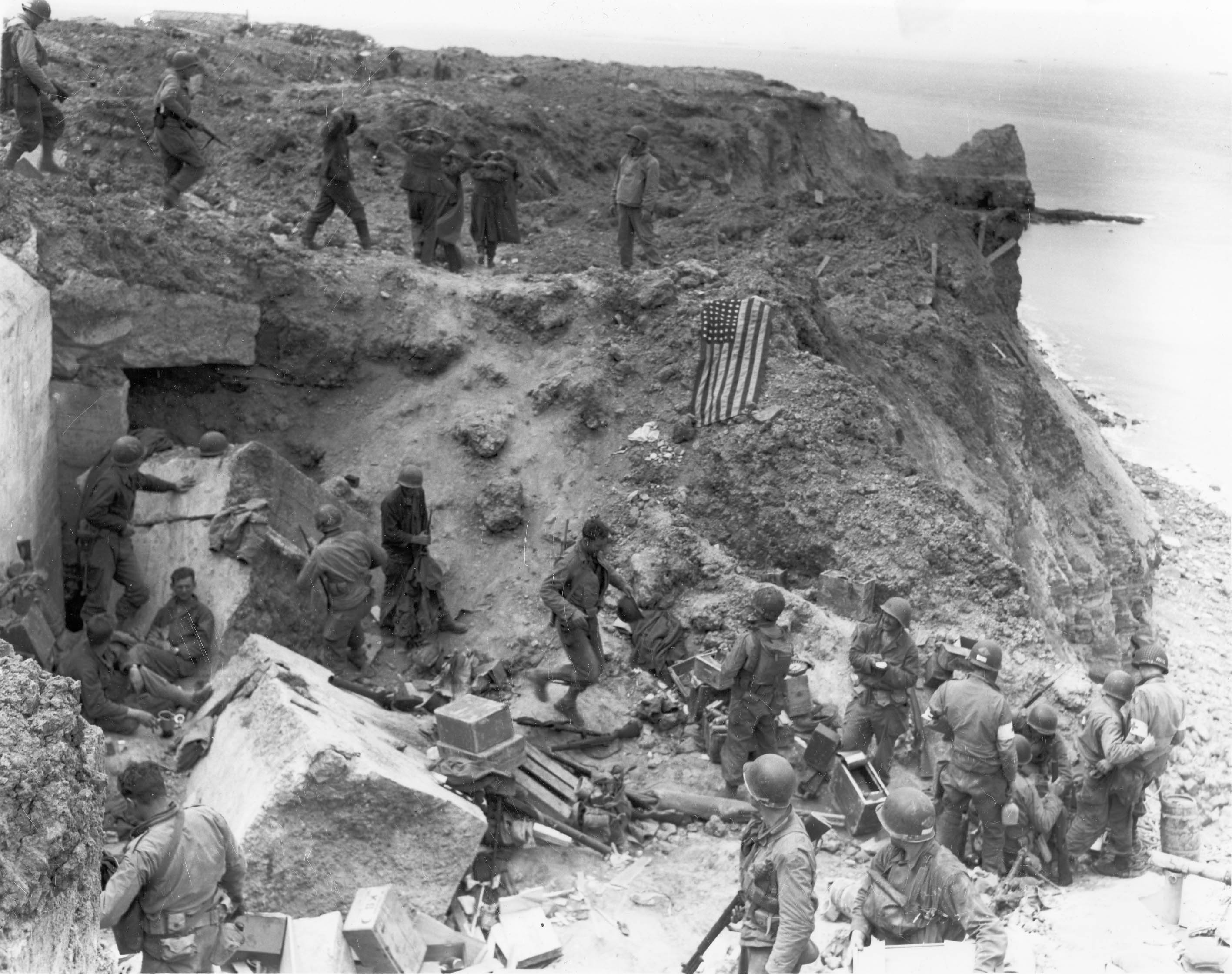
A few hundred yards back on the beach is a high bluff. Up there we had a tent hospital, and a barbed-wire enclosure for prisoners of war. From up there you could see far up and down the beach, in a spectacular crow’s-nest view, and far out to sea.
And standing out there on the water beyond all this wreckage was the greatest armada man has ever seen. You simply could not believe the gigantic collection of ships that lay out there waiting to unload.
Looking from the bluff, it lay thick and clear to the far horizon of the sea and beyond, and it spread out to the sides and was miles wide. Its utter enormity would move the hardest man.
As I stood up there I noticed a group of freshly taken German prisoners standing nearby. They had not yet been put in the prison cage. They were just standing there, a couple of doughboys leisurely guarding them with tommy guns.
The prisoners too were looking out to sea – the same bit of sea that for months and years had been so safely empty before their gaze. Now they stood staring almost as if in a trance.
They didn’t say a word to each other. They didn’t need to. The expression on their faces was something forever unforgettable. In it was the final horrified acceptance of their doom.
If only all Germans could have had the rich experience of standing on the bluff and looking out across the water and seeing what their compatriots saw.
Since this is a music blog I feel compelled to include music in most of my posts. As you contemplate my call to avoid wars in the future, listen to this great Joan Baez performance of a Bob Dylan song that highlights the ignorance of the commonly held view in the US that “God is on our side”……..
Oh my name it is nothin’ My age it means less The country I come from Is called the Midwest I’s taught and brought up there The laws to abide And that the land that I live in Has God on its side
Oh the history books tell it They tell it so well The cavalries charged The Indians fell The cavalries charged The Indians died Oh the country was young With God on its side
Oh the Spanish-American War had its day And the Civil War too Was soon laid away And the names of the heroes l’s made to memorize With guns in their hands And God on their side
Oh the First World War, boys It closed out its fate The reason for fighting I never got straight But I learned to accept it Accept it with pride For you don’t count the dead When God’s on your side
When the Second World War Came to an end We forgave the Germans And we were friends Though they murdered six million In the ovens they fried The Germans now too Have God on their side
I’ve learned to hate Russians All through my whole life If another war starts It’s them we must fight To hate them and fear them To run and to hide And accept it all bravely With God on my side
But now we got weapons Of the chemical dust If fire them we’re forced to Then fire them we must One push of the button And a shot the world wide And you never ask questions When God’s on your side
Through many dark hour I’ve been thinkin’ about this That Jesus Christ Was betrayed by a kiss But I can’t think for you You’ll have to decide Whether Judas Iscariot Had God on his side
So now as I’m leavin’ I’m weary as Hell The confusion I’m feelin’ Ain’t no tongue can tell The words fill my head And fall to the floor If God’s on our side He’ll stop the next war